Quantcast
Channel: BOOKTRYST
Viewing all 472 articles
Browse latest View live

Historic Van Gogh-Gauguin Letter Estimated $470,000 - $670,000 At Christie's

$
0
0
by Stephen J. Gertz


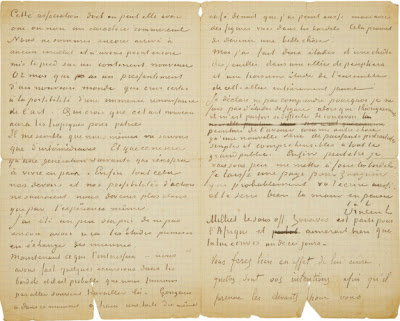
An astounding autograph letter co-written and signed by Vincent Van Gogh and Paul Gauguin to a third party discussing each other, their work together, paintings in progress, thoughts on a painter's association, and, amusingly, their exploration of the brothels of Arles, is being offered by Christie's-Paris in their Pierre Berès A Livre Ouvert sale on December 12, 2012.

It is estimated to sell for $470,000 - $670,000.

Van Gogh was a prolific letter writer; this is no. 716, found in the definitive, six-volume Vincent Van Gogh - The Letters: The Complete Illustrated and Annotated Edition, a massive project begun in 1994 under the aegis of the Van Gogh Museum in Amsterdam and published in 2009.
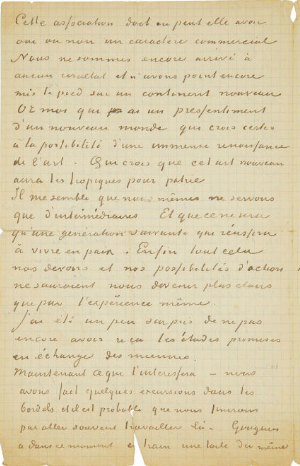

Though undated and without location, internal evidence points to it being written on Thursday the 1st or Friday the 2d of November 1888 and posted from Arles.

Van Gogh fled Paris in early 1888 and sought refuge in Arles. After repeated requests, Gauguin joined him on October 23d; they shared the four rooms that Van Gogh had rented at 2, Place Lamartine, the Yellow House. The letter was written a week after Gauguin's arrival.

Written to French painter and writer Emile  Bernard (1868-1941), in English translation it reads in full:

My dear old Bernard,

We’ve done a great deal of work these past few days, and in the meantime I’ve read Zola’s Le rêve,1 so I’ve hardly had time to write.

Gauguin interests me greatly as a man — greatly. For a long time it has seemed to me that in our filthy job as painters we have the greatest need of people with the hands and stomach of a labourer. More natural tastes — more amorous and benevolent temperaments — than the decadent and exhausted Parisian man-about-town.

Now here, without the slightest doubt, we’re in the presence of an unspoiled creature with the instincts of a wild beast. With Gauguin, blood and sex have the edge over ambition. But enough of that, you’ve seen him close at hand longer than I have, just wanted to tell you first impressions in a few words.

Next, I don’t think it will astonish you greatly if I tell you that our discussions are tending to deal with the terrific subject of an association of certain painters. Ought or may this association have a commercial character, yes or no? We haven’t reached any result yet, and haven’t so much as set foot on a new continent yet. Now I, who have a presentiment of a new world, who certainly believe in the possibility of a great renaissance of art. Who believe that this new art will have the tropics for its homeland.

It seems to me that we ourselves are serving only as intermediaries. And that it will only be a subsequent generation that will succeed in living in peace. Anyway, all that, our duties and our possibilities for action could become clearer to us only through actual experience.

I was a little surprised not yet to have received the studies that you promised in exchange for mine. Now something that will interest you — we’ve made some excursions in the brothels, and it’s likely that we’ll eventually go there often to work. At the moment Gauguin has a canvas in progress of the same  night café that I also painted, but with figures seen in the brothels. It promises to become a beautiful thing.

I’ve made two studies of falling leaves in an avenue of poplars, and a third study of the whole of this avenue, entirely yellow.

I declare I don’t understand why I don’t do figure studies,6 while theoretically it’s sometimes so difficult for me to imagine the painting of the future as anything other than a new series of powerful portraitists, simple and comprehensible to the whole of the general public. Anyway, perhaps I’ll soon get down to doing brothels.

I’ll leave a page for Gauguin, who will probably also write to you, and I shake your hand firmly in thought.

Ever yours,
Vincent

Milliet the 2nd lieut. Zouaves has left for Africa, and would be very glad if you were to write to him one of these days.


[Continued by Gauguin]

You will indeed do well to write him what your intentions are, so that he could take steps beforehand to  prepare the way for you.

Mr Milliet, second lieutenant of Zouaves, Guelma, Africa.

Don’t listen to Vincent; as you know, he’s prone to admire and ditto to be indulgent. His idea about the future of a new generation in the tropics seems absolutely right to me as a painter, and I still intend going back there when I find the funds. A little bit of luck, who knows?


Vincent has done two studies of falling leaves in an avenue, which are in my room and which you would like very much. On very coarse, but very good sacking.

Send news of yourself and of all the pals.

Yours,


Paul Gauguin


The late Pierre Berès (1913-2008) was more than a collector. He was "The King of  French booksellers," as the New York Times' obituary noted, towering over the rare and antiquarian book trade in Europe for seventy-five years until his death at age ninety-five. He was also a legendary figure in the world of art. He began as an autograph collector but soon shifted his attention  to books. His meteoric rise in the world of rare bookselling was fueled by acquiring collections of financially unstable French aristocrats and American millionaires during the Depression.

He was "a man renowned for his taste and connoisseurship, his vast financial resources and his ruthlessness in the pursuit of the rare and the beautiful" (NY Times obit). “I do not seek, I find,” he once cryptically declared about his preternatural ability to ferret-out scarce and desirable rare books from their hiding places.

"Rivals found him unscrupulous. In one celebrated instance he advertised in his own catalog some choice specimens that happened to belong to a competitor. When a client expressed interest, Mr. Berès told him to wait while he fetched the required volumes from his warehouse. Instead he raced to his competitor’s shop, bought the books and resold them" (Op cit, NY Times). If he was, at times, a scoundrel, he was the most elegant, charming, polished and sophisticated rascal to ever grace the rare book trade, in which scamps and scalawags can still be found but none with such savoir faire and cultivation. He was a consummate gentleman who seduced everyone he came into contact with and knew how to entertain them, routinely inviting buyers and sellers to his apartment on the Avenue de Foch for lunches and dinners after leaving them goggle-eyed at the literary and art treasures he displayed in glass cases and on the walls of his living room.

"Pierre Berès was a living legend on an international scale [and] also a character from a detective story: firstly because of his detective's flair and daring, secondly because of the mystery in which he liked to shroud his own persona, and lastly because of the subtlety of his business strategies that led him to store some of his finds and acquisitions...in his cellars to mature - sometimes as long as a half-century - like one would store fine wine" (Françoise Choay).
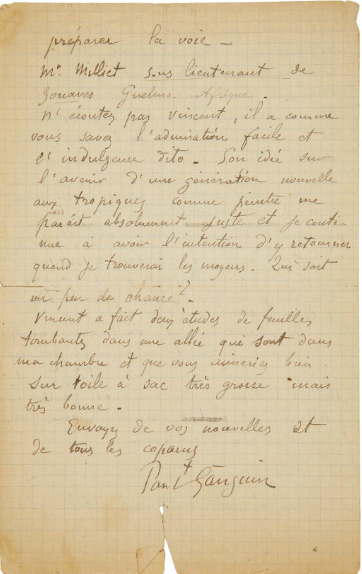

This letter was one of his prize possessions, marrying his two great loves, art and manuscripts. It is, arguably, Van Gogh's most significant letter, written at a key point in his career and about his most significant - certainly his most famous - relationship beyond that with his brother, Theo.

In an article, Les isolés: Vincent van Gogh, which appeared in the January 1890 issue of the Mercure de France and incorporated a passage from this letter, French writer and art critic, Gabriel-Albert Aurier (1865-1892), wrote of Van Gogh, "[he is] a dreamer, an exalted believer, a devourer of beautiful Utopias, who lives on ideas and illusions. For a long time he has taken delight in imagining a renovation of art made possible through a displacement of civilization: an art of tropical regions."

The two living side-by-side with incompatible temperaments, the atmosphere at chez Van Gogh soon turned tropical and Van Gogh and Gauguin's relationship began to wilt, Gauguin's domineering arrogance pushing Van Gogh over the edge. On December 23 1888 - less than two months after this letter was written -  a frustrated Van Gogh confronted Gauguin with a razor but in panic fled to a local brothel. While there, he cut off his left ear, wrapped it in newspaper and presented it to Rachel, one of the brothel's prostitutes, asking her to "keep this object carefully." He staggered home, where Gauguin later found him lying unconscious with his head covered in blood.

On January 2, 1889, a week after the incident, Van Gogh wrote to Theo from the Civil Hospital in Arles, letter no. 728:

My dear Theo,

In order to reassure you completely on my account I’m writing you these few words in the office of Mr Rey, the house physician, whom you saw yourself. I’ll stay here at the hospital for another few days — then I dare plan to return home very calmly.1 Now I ask just one thing of you, not to worry, for that would cause me one worry too many.

Now let’s talk about our friend Gauguin, did I terrify him? In short, why doesn’t he give me a sign of life? He must have left with you.

Besides, he needed to see Paris again, and perhaps he’ll feel more at home in Paris than here. Tell Gauguin to write to me, and that I’m still thinking of him.

Good handshake, I’ve read and re-read your letter about the meeting with the Bongers. It’s perfect. As for me, I’m content to remain as I am. Once again, good handshake to you and Gauguin.

Ever yours,

Vincent


Bygones be bygones...
__________

The Van Gogh-Gauguin letter, in the original French and English translation with footnotes, can be found here.
__________

Images courtesy of Christie's, with our thanks.
__________
__________

Breaking News from the Sixteenth Century: Typography Takes Off

$
0
0
by Alastair Johnston


Stan Knight, Historical Types (From Gutenberg to Ashendene), Oak Knoll Press, 2012, 104 pp., hardback in dust-jacket, $39.95

Historical Types is based on a smart concept: an annotated picture book of enlargements of typefaces to show how they really look. After all, type is that tiny code we look at without really seeing it: it gives meaning to thoughts, but we rarely give it a thought.

Obviously this approach -- enlarged images of letterforms with commentary -- has been a key part of modern typographic education. A lantern slide show by Emery Walker in 1888, given to the Arts & Crafts Exhibition Society in London, where he projected blown-up images of Jenson, Ratdolt and Rubeus pages, inspired William Morris to start his own press. Walker, a commercial photo-engraver, went into partnership with T J Cobden-Sanderson to start the celebrated Doves Press after Morris' death. Bruce Rogers, who also knew Walker, had photo-enlargements of the Jenson pages made to draw his Centaur type.

As a teacher I rely on large projected letterform details to explain their subtleties. I often use images from a wonderful article, "Photographic enlargements of type forms" by Philip Gaskell, that was published in the Journal of the Printing Historical Society, no 7, 1972 (and is missing from Knight's bibliography). Gaskell's photos, which were printed 5 times actual size, have proven enormously useful in discussing type design and its evolution and are a significant precursor to what Knight has done.

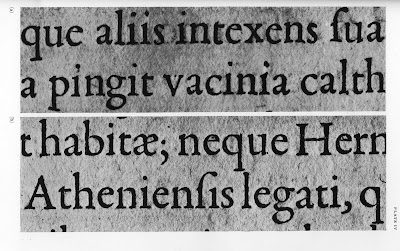
Two gros romain romans attributed to Claude Garamont, from Gaskell's article in Journal of the PHS, 1971. The top type, from 1530, has since been identified by Dr Vervliet as the work of Maître Constantin (from Virgil, Opera, Paris: Robert Estienne, 1532 [R115]); the lower type, from 1549 (as seen in Dionysius Halicarnassus, Scripta Omnia, Frankfurt: Andrea Wechel's heirs, 1586) is by Garamont [R118]

However didactic his aim, Knight has not achieved the same compression and intensity that Gaskell did (in 11 pages!), perhaps because his book is aimed halfway between scholars or students and a general audience. But Knight has provided accurate information on these typefaces. This may sound odd, given that so much has been written over the last five centuries about the legacy of Gutenberg, Fust & Schoeffer, Jenson, and so on.

Faustus and Chauffeur (dubious attribution)

But we have discovered a lot of it is speculative or inaccurate and we can no longer rely on Stanley Morison, Beatrice Warde and D B Updike for facts about the design of type. In discussing Ratdolt's work, Knight cites studies from 2009 and 2011 (showing how type scholarship is constantly evolving). Fortunately we have James Mosley, who teaches at Reading, Charlottesville (Virginia) & London Universities, formerly the Librarian of Saint Bride's in London, as a guiding light in the search for typographic truth. Mosley has been blogging about such matters since 2006. His "typefoundry" blog has been a great resource for Knight, particularly in the untangling of Jannon versus Garamond, the actual spelling of Garamont's name, and other details.

Many documents have appeared to further the historical discussion, from the series of Type Specimen Facsimiles (under the editorship of John Dreyfus from 1963 onward), to the exemplary Enschedé (1993) & Plantin-Moretus (2004) facsimiles edited by John Lane. Some of the older facsimile works could be revisited with the new approach heralded by Knight, but others could not, for example the 1592 Egenolff-Berner specimen sheet which was discovered in a Frankfurt University library in 1926 by Gustav Mori and reproduced in collotype -- fortunately for us, as it was destroyed in an Allied bombing raid in World War II. That sheet was the first specimen broadside to clearly identify Garamond and Granjon as cutters of their types and, as it was printed from newly cast type, was the best possible source for modern interpretations: Adobe Garamond by Robert Slimbach (among others) was drawn from it.

But for most of the twentieth century Garamond revivals (and there have been roughly a zillion of them) were based on the wrong type: a poor imitation cut by Jean Jannon in the French province of Sedan in the 1620s. This typographic Lady Gaga, a tragi-comic homage to classic typefaces, should have been left in the dustbin of history but accidentally gained an important place in the story of type development, so Knight has included it. Also included is a text debunking many of the myths about Jannon and Garamond (thanks to Mosley's research). One of the most fanciful stories has Cardinal Richelieu's troops looting Jannon's types to bring them back to the Imprimerie nationale in Paris. This yarn was first spun by Beatrice Warde in 1926 and picked up by Warren Chappell in his Short History of the Printed Word. As late as 1999 Canadian poet Robert Boringhurst was embroidering the fable in his edition of Chappell's book (p. 148), saying that after Richelieu’s armies seized Jannon’s type they felt bad about it so they reimbursed him for them!

As technology improves it greatly assists us in seeing what we are looking at (though collotype mentioned above is hard to beat). Up to now many books on type have used small illustrations of large pages shrunk down, printed from line blocks. In the end you cannot see any details. So the next step is to do more books of this kind that show, as closely as possible, the impression and the texture of the paper, and more specialized books. Knight's previous book was Historical Scripts (also from Oak Knoll) with a similar hyper-visual approach to the history of calligraphy.

Hendrik Vervliet's recent three volumes on the Paleotypography of the French Renaissance have illustrations from Xerox copies and photostats. [Aside: I published Vervliet's monograph on Robert Granjon: Cyrillic & Oriental Typography in Rome at the End of the Sixteenth Century in 1979. We relied on Velox photostats from the Vatican for illustrations, which were so poor, some were even out of focus, but how do you tell the Vatican their reproductive services are lacking?] Vervliet's images (many composites to show full character sets) were painstakingly assembled over decades and often Xerox was the only service available. It would be a useful task for someone to give the blow-up treatment (shot in high resolution with raking light to show the impression, as well as the paper surface) to his studies (now that we have the key data assembled), and then move into the following centuries. 

Garamont's gros romain roman [R118] from the 1599 Le Bé-Moretus specimen shown in Vervliet, French Renaissance Printing Types, 2010, p. 193

Nevertheless Vervliet's work is the major contribution to the field in the last half century. So it's great to see late-breaking news from the sixteenth century when Knight reproduces a page of revolutionary new type from Henri Estienne (previously attributed to Garamond [see top illustration]) and, thanks to Vervliet, we now have to acknowledge the shadowy Maître Constantin for this massive step-forward in the Aldine style which revolutionized roman letterforms across Europe.

Claude Garamont's gros romain roman as seen in Les Vies des hommes illustres, Paris: Vascosan, 1559, shown in Knight (p. 41)

I myself have done a little work in the eighteenth and nineteenth centuries but that indicated to me how much more needs to be done. Knight himself admits this is just a start: "Some worthy type designers like Pierre Haultin, Hendrik van den Keere, and Antoine Augereau are missing. But as well as the more famous names of Gutenberg, Granjon, and Bodoni, I have been able to include some lesser-known designers like Erhard Ratdolt, Simon de Colines, Johann Fleischman, and Alexander Phemister."

While to me there seem to be some close calls on who got omitted versus who got in, I think the general reader will enjoy the familiar mixed with the more exotic. The reader may balk at the name Miklós Tótfalusi Kis and be unaware that they have been lôôking at his type and versions of it all their lives.

I am sorry there is such a sadly inevitable bias towards the private press movement at the end of this study. There is certainly enough about William Morris, Cobden-Sanderson and St John Hornby out there in bibliomundo. A page on their cutter Edward Prince could have covered all of them (and freed up two pages). The Ashendene Subiaco type is a joke, or at best a footnote to the Sweynheym & Pannartz page; Eric Gill's Golden Cockerel type would have made a nicer terminus to the work. Otherwise, moving from Fournier to Bodoni is a big leap without including both Bodoni's early types that were imitation Fournier and the truly revolutionary types of Firmin Didot (which were cut by Pierre Wafflard). There is no easily accessible text in English which covers these most important steps forward in type design. William Martin (1757–1830) and Vincent Figgins (1766–1844) would have been solid inclusions and, despite most modern typographers' disdain for the excesses of the Victorian period, it cannot be ignored, but Phemister is the sole representative. (However, he and 26 other nineteenth-century type-cutters are covered in William Loy's book Nineteenth-century American Designers & Engravers of Type [Oak Knoll Press, 2009].)

In compressing info Knight has mixed up the legacy of Caslon: Mrs Elizabeth Caslon did not start the H W Caslon Foundry, that was 30 years later, and I really don't agree with using italic parentheses! For the most part the photos are excellent and give us true insight into the intricacies of these typefaces.

For all of its superficial appearance as a "coffee-table" book on printing types with pretty pictures, Knight's work is a solid piece of scholarship and corrects a lot of misconceptions found in "standard" texts that give a resumé of the development of printing types.
__________
__________

Literary Matchboxes Light Up Christmas Stockings (Close Cover Before Striking)

$
0
0
by Stephen J. Gertz


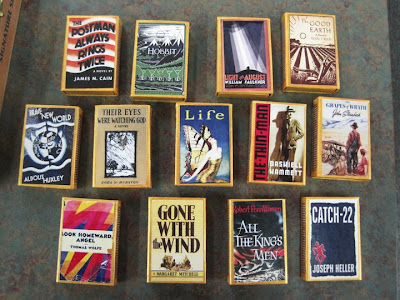
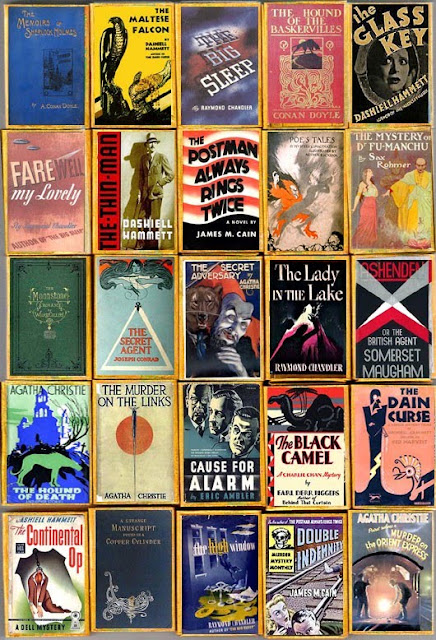
Those seeking the perfect match when Christmas (or any other kind of) shopping for friends with a literary bent (and all book lovers are proudly a little bent) should look no further than The Matchbox Museum of Fine Arts, the brainchild of Los Angeles-based designer Hillary Kaye. Not simply its curator she's its creator, taking Diamond matchboxes and reproducing celebrated book dust jacket designs upon them.

Point-of-sale display case.

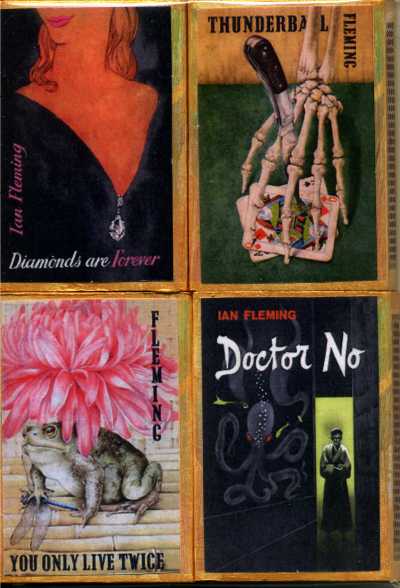
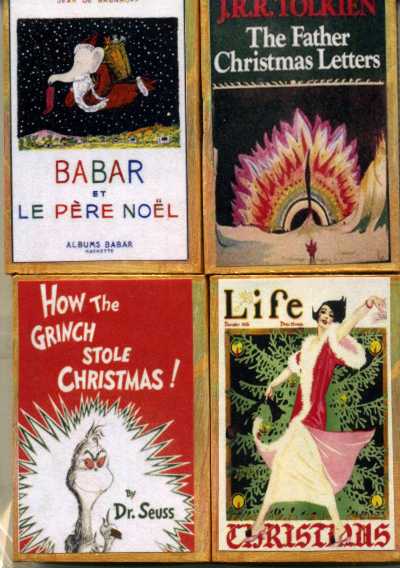
I was turned onto them by a friend who recently presented four sets of the Museum's Petit Fours to me, packages containing a quartet of similarly themed matchboxes.


Delighted and intrigued, I contacted Hillary Kaye to find out what's what and where to get these 1 1/3 x 2 inch tiny gems.

Petit Fours, above and below.

“Tiny gems” is a perfect description of the matchboxes," she responded, "exactly how I see them, each one a miniature world. They’re based on the Diamond penny matchbox which I’ve always found visually pleasing. Only recently when I started working with them did I discover they are the exact dimension of the 'golden rectangle,' a shape used in classical antiquity and the Renaissance because of its aesthetic proportions.

(Upper edges accidentally cropped).

"I created The Matchbox Museum of Fine Arts to help make people aware of the heritage of visual imagery from the golden age of illustration. It can be a memento of favorite books for readers and collectors and an introduction to classics they might have missed.


"I’m guessing your friend must have bought the Petit Fours at Vicente Foods market as they are the only place local [to me, in West Los Angeles] that has them. I sell to indie bookstores not the big chains. They're available in twenty-three States across the country including Tattered Cover, Books and Books, Square Books, etc. In L.A.  they’re also available at Skylight Books, Book Soup and a number of other stores.

Actual size: 1 1/3 x 2 inches each.

"Other than a minimal exposure at www.iceboxicons.com/matchboxmuseum.htm which is basically for paypal ordering; so far I don’t have a website for the matchboxes. Since 9/11 matchboxes can not be sent through the ordinary mail, just UPS. The shipping price for small orders would be high.

From the classic crime series. Scores available in other genres.

"Sets of the matchboxes in a display box have been available at some of the bookstores and I have considered making them available online for collectors. I do special orders on request."


This year set Christmas afire with literary classics from The Matchbook Museum of Fine Arts. If your local indie bookstore or rare book shop doesn't have any,  insist, pester, and persist until they stock them. I have little doubt that they will be great, point-of-purchase impulse items and steady sellers as all-year round gifts to friends.

Dealer inquiries can be directed here.
__________

Of Related Interest:

Time For Vintage Book Clocks This Christmas.

The Ultimate Gift For Book Lovers.

Rare Book Trading Cards On Santa's Top Shelf.
__________
__________

Nice Ass, Great Binding

$
0
0
by Stephen J. Gertz


In 1904, publisher George Bell and Sons issued a beautifully designed and printed edition of the ancient classic The Golden Ass, aka Metamorphosis, by Apuleius in its 1566 English translation by William Adlington. Published in an edition of 200 numbered copies for sale, it was printed by the Chiswick Press.

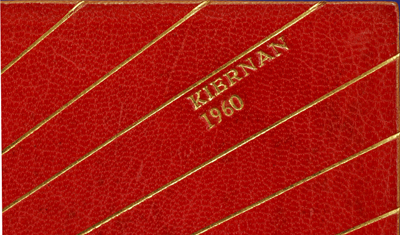
In 1960, a copy of the Chiswick Golden Ass received fine binding treatment.  It was bound by Bernard Kiernan.

Now, in 2012, that copy is the subject of a Booktryst post with teasing headline of dubious taste. Aim high, swing low.

Title-page.

Kiernan bound the copy in full light brown morocco with fifteen onlaid deep purple morocco medallions with a radiating sun motif in gilt to the upper and lower boards, each medallion encircled by a black morocco border. Six compartments with onlaid gray morocco hexagons and black morocco label lettered in gilt grace the spine. Inside, burnt orange morocco doublures with gilt rays emanating from a plain central oval stagger the eyes when the book is opened. All edges are gilt.

Few are aware of master bookbinder Bernard Kiernan (1922-1967). Bernard Henry Kierman  took up bookbinding as a hobby in 1954 at age thirty-two. He was largely self-taught and became a member of the Guild of Contemporary Binders in 1958 and exhibited at Foyles in the same year. He was elected a Fellow of the Guild but, alas, died in 1967 at age forty-five. Bibliographer J.R. Abbey had a number of books bound by him, one of which is illustrated in The Anthony Dowd Collection of Modern Bindings (John Rylands University Library, 2002, pp. 106-7). He also bound a copy of Craig's Irish Bookbindings 1600-1800 which was in William Foyle's collection. A copy of Charles Holme's The Art of  the Book bound by Kiernan is found in the British Library. Many volumes in the Gutteridge collection of books on cricket were bound by Kiernan. He was held in high regard for his original designs and tooling skills, as splendidly displayed here. His career was short, his work distinguished.

Cover detail.

Few, if any, care about publisher George Bell and Sons. But The Chiswick Press is another matter entirely. Peel back the skin of the Private Press movement and the enormous influence of the Chiswick Press lies exposed.

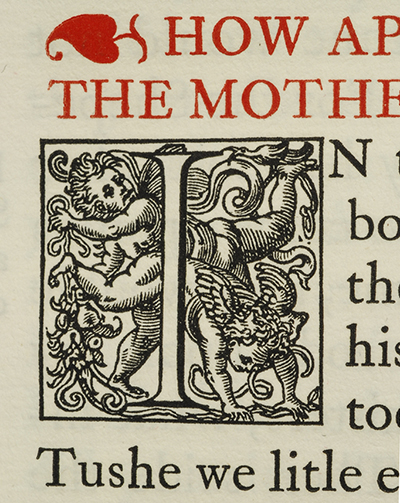
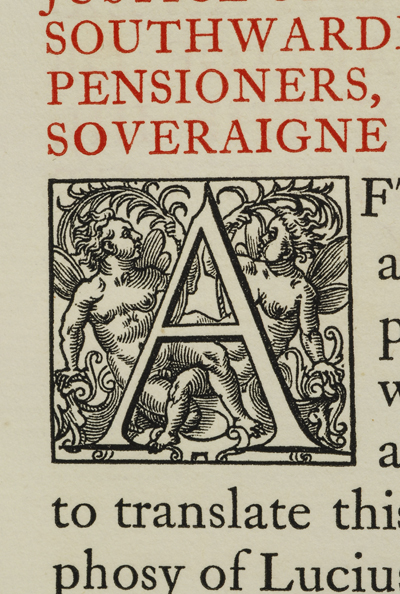
Woodcut historiated initial.

"Chiswick Press was established in the printing shop of Charles Whittingham (1767-1840) in 1787. Although the press moved on a few occasions, it operated for the most part in London, England. Chiswick Press became influential in English printing and typography and, most notably, published some of the early designs of William Morris. The press continued to operate until 1962" (Special Collections, University of Missouri Libraries).

Front doublure.

In 1811, Whittingham began printing inexpensive editions of the classics. In 1838, his nephew and apprentice of the same name, Charles Whittingham (1795-1876), assumed control of Chiswick, and under his stewardship the press revived old typefaces and made a concerted effort to improve the quality of typographical design and printing in England, which had fallen low.

Historiated initial.

The high quality that Chiswick Press brought to English printing became the craft's gold standard in the U.K. Chiswick Press was a trade printer - Great Britain's finest -  servicing publishers (it became the most in-demand print shop of nineteenth century England), but its influence extended beyond job work. It played an important role in the development of the Private Press movement, which strove to meet and exceed the mastery of the Chiswick Press. They printed many of William Morris's early books, and the great printer and designer, Emery Walker, a founding father of the Arts & Crafts movement who established the Doves Press with T.J. Cobden-Sanderson in 1900, used the Chiswick Press to print  an edition of  Burns' The Pied Piper  of Hamelin in 1889. The Chiswick Press printed books for the Riccardi Press, the Folio Society, Boar's Head Press, etc.

Stamped signature to rear doublure.

I don't pretend to know all there is to know about rare books; I only became aware of the Chiswick Press a few months ago yet I consider it an embarrassing lacuna in my knowledge. Now, as if seeing a previously unknown consumer product or car for the first time, I  find references to it all over the place. And this copy of The Golden Ass bound by Kiernan holds a place of honor.
__________

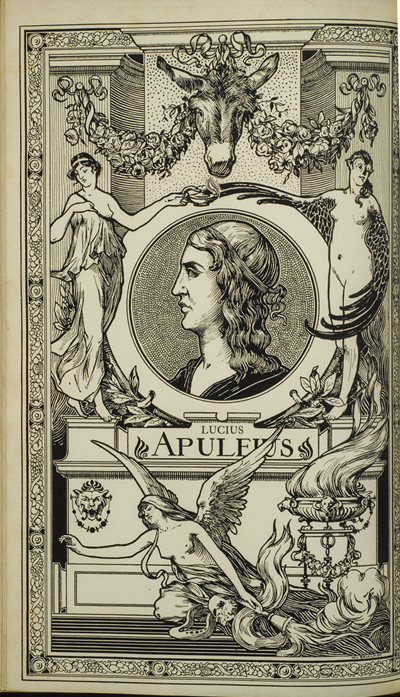
Frontispiece.

[KIERNAN, Bernard, binder]. APULEIUS. The Golden Ass. Translated by William Adlington. London: Chiswick Press for George Bell and Sons, 1904.

One of two hundred numbered copies, this being copy no. 195, out of a total edition of 220. Quarto (13 1/8 x 8 in; 335 x 203 mm). [17, blank], [1, limitation], [1, half-title], [1, blank], [6], 226, [1, colophon], [11 blank] pp. Frontispiece and title page by W.L. Bruckman; title page in red and black. Rubricated headlines and running heads, text in black. Historiated woodcut initials in black. Shoulder notes in red and black.

Bound in 1960 by Bernard Kiernan.
__________

Many thanks to Edward Bayntun-Coward for information about Bernard Kiernan.
__________

Images courtesy David Brass Rare Books, with our thanks.
__________
__________

Time Out For Booktryst

$
0
0
by Stephen J. Gertz


Booktryst takes five this week and will return with new posts next Wednesday, December 26.

In the meantime, relax over the next few days and enjoy a few oldies but goodies  from the Booktryst archive until we reappear.


__________
__________

On The Road With Minnesota Fats - A Booktryst Golden Oldie

$
0
0
by Stephen J. Gertz


“I’ve been shooting pool since I was four years old. No con. By the time I was six I was playing for stakes. My first sucker was a neighborhood kid in Washington Heights. I spotted him coming out of a candy store with an enormous bag of gumdrops. He was about five years older than me but I shot him straight pool and I won every last one of his gumdrops. He went home crying. When I was ten I started playing for cash” (Minnesota Fats, The Bank Shot and Other Robberies).


My introduction to Minnesota Fats, legendary pool hustler:

It’s 1986. After arriving late into Nashville, I check into the Hermitage, the hotel where Fats, 73, lives rent-free in exchange for hanging out on the hotel’s mezzanine and shooting pool for and with the guests for a few hours each day. He’s in the lobby, lounging on a sofa with two very attractive women draped over him like shawls.

“You’re late, Kid,” he caroms in a gruffly quiet yet very emphatic New York accent. I’m thirty-five. “I got the double-double on these tomatoes. It’s harvest time. I’ll catch you on the break.”

He stands up, the chicks attach themselves to his arms, and the three vamoose to his room.

I catch him on the break – at breakfast the next morning.

“Let’s belt out some calories,” he commands, “and we’ll talk the proposition.”


Said proposition: I’m in town to supervise a brief promotional tour for Fats’ first (and only) video, How To Play Pool Starring Minnesota Fats (Karl-Lorimar Video, 1986). It is also the exact time that Martin Scorsese’s The Color of Moneyis being released. Disney gave me the double-door when I proposed a promotional alliance, and now, just for spite, I’m determined to piggy-back onto The Color of Money because the color of money is the same hue for both projects and we need to sell 15,000 copies for the video to break even.


I’ve set up a release party in Nashville with the help of a local music industry publicist who’s promised to deliver the city’s Country-Western stars; Waylon Jennings is in the video as Fatty’s guest, everybody in town loves Fats, and, I'm assured, it’s a Hungarian cinch that the party will be star-studded. The publicist is also a very attractive woman, a fact that will go a long way toward ensuring Fatty’s ongoing cooperation because he put the cranky in cantankerous and cannot be moved by anything other than money on the table or a gorgeous babe. As there is no money on the table (or anywhere else) for him to be paid for his promo toil, this is not an effort he is enthusiastic about enduring, and the big maha from the home office, me, does not impress him at all. For all I know, Fats considers me strictly a filage.

Breakfast conversation quickly turns from the proposition to all the people Fats has known “since time began.” Fats has a generous sense of temporal existence. He, in fact, has a generous sense of just about everything and has turned hyperbole into high art. A woman is not merely beautiful, she is beautiful “beyond compare,” she “makes Raquel Welch look like an onion.” He is, also, “the greatest storyteller since Aesop,” and after listening to him for a while I know he’s on the square; I could listen to him for hours. He speaks in a colorful patois, the language of poolrooms, gamblers and hustlers, and I want to hang a jewelry box around his neck like a feed bag to catch the pearls that routinely fall out of his mouth. He is an enchanting, if sometimes difficult, personality.
 
David Kastle, Fatty’s manager, has joined us. David is a few years younger than I am, a sharp guy who fell in love with Fats and decided to take him on and reinvigorate his career, which had faded with his advancing age leaving not much more than the legend. But a legend is not legal tender; bills have to be paid with cash. The legend needed to be leveraged. The video deal is a first step and David will be accompanying us for the duration. He, too, wants everything to run smoothly. David can handle Fats – up to a point. When reason fails, bring in the girls.

I spend the afternoon frantically going over arrangements with the publicist who lulls me into a sense of nervous prostration. Everything will be fine – unless it isn’t.

Dolly Parton, George Jones, and the rest of the stellar cast of promised Country-Western artists have, evidently, made other plans for the evening - they are not standing by their man - and the press has, apparently, other pressing engagements. I’m dying, David Kastle is fuming. The publicist blames a misalignment of the planets.

Fatty, on the other hand, couldn’t care less. Salesmen and the V.P. of Ingram Distribution’s video division are in attendance and eager to shoot a little pool with the legend, who has no qualms about separating them from their simoleans and it doesn’t matter whether it’s two-bits, a single, a fin, a ten-spot or a deuce that’s on the table, money means action and he’s as predatory as if a carbuncle had been laid on the felt. No matter how shallow or deep the green, Fatty sees red, smells blood, goes in for the kill, and whacks out all of ‘em. But never have losers felt so much like winners: the salesmen now have a story, How Minnesota Fats Wiped the Table With My Ass, that they’ll be telling for the rest of their lives.

Were it not for its motivating effect upon the sales force – a fact far more important than having stars show up – the release party would have been a complete scratch. It is an ill-wind omen of things to come, as is the brick itching to evacuate my bowels.
 
Afterward, Fats, David, the publicist, the Ingram V.P., and I grab a late dinner and, once again, Fatty regales with stories about Willie Mosconi– his pool-universe arch-enemy; Princess Fatima, who appreciated his moves with a stick; Zsa-Zsa Gabor; the day Dillinger dropped; Russian pinochle on the high seas; craps on the Hudson; a south-of-the-border standoff (“El Gordo,” the Fat One, wins); the sultans, viziers, rajas, ranis, maharajas, the crowned heads of Europe, the potentates of all stripes that he's met, and other fables from a fabled life.

With all his talk about knowing everyone since God created the heavens and earth, I can’t help but try to throw him a curve to see if I can force a strike.

“Did you know Louis Levinson?” This was a cousin of mine, actually one of my paternal grandfather’s first cousins, an ultimately deceased by unnatural cause citizen of Chicago who might just as well have been a denizen of Damon Runyon’s Broadway, an underworld character of color with a legend of his own.
 
He swings.
 
“Sleep-Out?” 
 
Home run.
 
But before I can confirm that yes, I am referring to “Sleep-Out Louie" Levinson, second-story man in youth, a gambler of renown and owner of Club Flamingo, a rug-joint (an illegal casino with carpeting to attract the straight, monied class, as opposed to the standard clandestine, no-frills sawdust-joint) in Newport, Kentucky, Fatty proceeds to weave the tale of how “Sleep-Out “ earned his moniker, a story I was weaned on: He lived at home but his professional activities were nocturnal and he’d often return at all hours of the early morning, if he got home at all. More often than not, he’d just lie down on a table in the local pool hall and cop z’s, hence “Sleep-Out.”

When he didn’t show up at home, his mother, my grandfather's Aunt Mary, a big bear of a Russian Jewess who, had she remained in the Motherland, could have crushed Hitler’s invading army simply by falling on it, would go out looking for him, her first stop the pool hall where she’d find him sawing logs comfy on the green felt, grab him by the ear and march him out of the pool room, down the street, and home like he was a five-year-old juvenile delinquent. This scene would invariably inspire hysterics in bystanders innocent and otherwise.
 
"Sleep-Out" earned a couple of footnotes in the Federal annals during his career. At the 1951 O'Conor Senate Committee Investigating Organized Crime in Interstate Commerce hearings, the following burlesque routine occurred during the October 16th session:
 
Witness: John Maddock, bookie.

Mr. Rice. Have you ever transacted any business with Howard Sports in Baltimore?

Mr. Maddock. Who is Howard Sports?

Mr. Rice. Howard Sports, the news service.

Mr. Maddock. I refuse to answer that on the grounds I might incriminate myself.

Mr. Rice. In 1944, did you transact any business with Howard Sports ?

Mr. Maddock. I refuse to answer that on the grounds I might incriminate myself.

Mr. Rice. Do you know a man by the name of Sleep-out Louis ?

Mr. Maddock. I refuse to answer that on the grounds I might incriminate myself.
 
Later that same day:
 
Witness: Meyer Rosen “sporting figure” in Baltimore, the night-shift bartender at Phil's Bar, a job that covered his bookmaking activities:

Mr. Rice. I have a series of checks here, I wonder if you can help us out on these. They are drawn on that account [Phil's Bar]. Here is one drawn December 13, 1945, on that Maryland Trust Co. account to Louis Levinson in the amount of $7,227, deposited in Newport, Ky.

Mr. Rosen. I don't know anything about it.

Mr. Rice. Did you ever hear anything about Louis Levinson?

Mr. Rosen. Never heard of him.

Mr. Rice. Wouldn't know any reason why "Sleep Out Louie" would be receiving $7,000 from Phil's Bar account?
 
Mr. Rosen: I refuse to answer on the grounds that it may incriminate me.
 
"Sleep-Out" was, apparently, held in such high esteem by his colleagues that to even admit to his existence was considered a profoundly rude discourtesy, anti-social behavior that might land you in the slammer - or worse. His brother, my "Uncle" Eddie Levinson, was one of Meyer Lansky's top lieutenants ("Eddie Levine" gets a slice of the Cuba cake in Godfather II), running Meyer's casinos in Miami, Havana, and Las Vegas.
 
Suffice it to say, when news of my connection to Sleep-Out hits Fatty's ears my stock with him rises into the stratosphere. I'm practically family. It won't last long.
 
Our first and last stop on the grand tour is Atlanta. Ingram has set up a few in-store appearances for Fatty, the Atlanta premiere for The Color of Money will occur while we’re in town, and I’ve heard a rumor that Paul Newman and Tom Cruise will be racing at the Atlanta Speedway that weekend. This is our opp to glom on to The Color of Money like green on a pea.
 
Make it happen, I tell the publicist, who, as insurance for Fatty's continuing cooperation, I insist must accompany us to Atlanta.
 
Just how we got to Atlanta from Nashville is lost to me, contrary to Montaigne's dictum that "nothing fixes a thing so intensely as the desire to forget it." Chalk it up to Post-Traumatic Stress Disorder.
 
We arrive at our hotel, dump our stuff, eat lunch, and head for the first video store on the schedule. Ingram, apparently, sub-contracted the in-store promotion and publicity to the CIA because all evidence points to Fatty's appearance being a state secret. David Kastle is royally pissed, the publicist is tsk-tsk-ing, I'm beside myself (always one too many) with aggravation, and "El Gordo" is irritated "beyond compare." We go through the motions with a few people who accidentally walk into the store, and wrap up this disaster before FEMA shows up.
 
The store didn't even have any copies of the record on hand.


I couldn't bear any of the promotional tchotchkes that vendors had been offering - how many variations on an 8-ball can there be? Plenty, it turned out: 8-ball keychains, 8-ball paperweights, 8-ball slip-on pencil erasers, pens with a hula girl with 8-ball breasts, 8-ball balls, etc. (including a cue stick pen). So when David Kastle told me that he'd recently thrown Fats into a recording studio with a bunch of young, adoring guys and dolls, had Fats tell his stories, and taped the whole thing, I ran some numbers and realized we could press and package a record for only three cents more per unit than the cost of the lame promo gifts I was offered. Hence, The Sultan of Stroke: The Legendary Minnesota Fats in His Own Words. Mea culpa: my title.
 
Because when he spun his amusing folk tales of pool hustling life he employed his own, incomparable, often indecipherable argot, I reprinted the glossary that appears within The Bank Shot and Other Robberies, Fats' autobiography and the best book that Fats had anything to do with, on the back of the album cover as A Brief Dictionary of the English Language by Minnesota Fats. Any one with an interest in weird words and phrases needs to get a copy of this book; there are things within the glossary that I've never seen in any slang dictionary, or heard elsewhere. Space precludes a full reprint; here are a few gems, in Minnesota Fats' own words:
 
A Filage: An out-and-out fraud. An impostor claiming he's a chef when he can't even fry an egg. (The word, of French origin, is slang for cheating, as in palming a card, or faking, as in bluffing. I use it as a noun and a verb).
 
Who Shot John?: Ridiculous conversation, ridiculous beyond compare.
 
Hungarian Cinch: A proposition where there's no way to lose. A sure thing, a mortal lock.
 
A Carbuncle: A Gargantuan bankroll, like maybe the size of an eggplant.
 
A Tomato: A doll whose natural endowments are exquisite beyond belief.
 
A Multi: A person who not only has millions but lives like he has millions.
 
A Big Maha: A very important person who moves like a very important person. (Short for Maharajah).
 
The Double-Double: extra-strong sweet-talk, usually accompanied by a smile.
 
The Double Door: To get rid of somebody real quick, like walking in the front door of a joint and out a side door.
 
The Horns: When there's no way to win a bet on account of somebody has put a curse on you.
 
Tush Hog: A very tough guy who is always looking to use muscle on somebody.
 
Triple Smart: An extremely intelligent person who is not only three or even more times more intelligent than a very intelligent person, but whose intellectual capabilities border on the phenomenal. A triple smart person is such a rare and extraordinary individual that only one comes along in a whole lifetime. (In my long and illustrious career, I've also been known as both Double Smart Fats and Triple Smart Fats).
 
Tapioca: The never-never land of busted gamblers. A very, very lonely and hideous place indeed.

• • •

The other video store on the calendar? A sensory deprivation tank with cash register and drop-in box.
 
By this time, I'm feeling in the thick of the pudding, Tapioca's favorite son.
 
We eat dinner at a coffee shop near the theater where The Color of Money will shortly make its Atlanta debut. Sitting at the counter, we have two women flanking us who, upon overhearing our conversation and learning who the old guy with us is, lean in so close that Fats now has human epaulets on his shoulders. Please believe me when I tell you that they soon opened their purses, took out the keys to their hotel rooms across the street, and presented them to Fats. I have never seen anything like it. Young, old, and all women in between fell all over Minnesota Fats when he opened his mouth. His name and legend were a free pass to Mount Venus.
 
We can see a crowd forming in front of the theater with a line snaking up the street and around the corner.
 
"I'm not standing in no line," Fats states as inarguable fact.
 
Not a problem. I walk our group up toward the entrance and whisper to the theater crowd control kid the identity of the old man in our party, a whisper modulated so that only people within a half-mile radius can overhear. 

Magically, the crowd parts like the Red Sea. Oohs, ahs, and hushed bruits accompany our promenade through the mob, into the theater, and into our seats because every one alive has heard of Minnesota Fats but few have ever seen him; the legend precedes him like Jane Mansfield's rack and, like same, everyone wants to bump into it, if for no other reason than a reality check.
 
"Minnesota Fats" was born Rudolf Wanderone in 1913 in Manhattan's Washington Heights neighborhood. When he was ten years old, his father took him to Europe to study with the great German billiards player Erich Hagenlocher. He won his first major tournament when he was thirteen. He left school in the eighth grade and began his life as a traveling pool hustler. Over the years he became known by many variations of the handle "Fats:" Triple Smart Fats, Broadway Fats, Chicago Fats, etc. He was New York Fats when The Hustler came out in 1961. When Willie Mosconi, who had been the technical adviser on the film, let it slip that the fictional character "Minnesota Fats" in the movie was based upon New York Fats, Rudolf "New York Fats" Wanderone, approximately a nanosecond afterward, exploited the situation, appropriated the character's name, and Minnesota Fats - a real, living person and instant legend - was born. He became a popular guest on television talk shows, noted as much for his entertaining manner as his pool skills. And he loved the limelight.
 
The limelight had dimmed to near dark, and the pathetic direction of this little tour had become a humiliating embarrassment for Fatty, who, incidentally, hated The Color of Money. My affection for Fats had grown deep, my well of guilt was overflowing its large capacity, and I definitely felt like a cheap filage.
 
He was not happy about schlepping out to the Atlanta Speedway on the off-chance that we might catch Newman and Cruise and capture publicity. The publicist, who was now assuaging Fats' mounting irritation with full-time cooing that was losing its ability to calm, was dubious about us getting in. I insisted that we try.
 
We arrive at the Speedway and pull into the parking lot. A young attendant stops us. The publicist, who is driving with Fats in the passenger seat next to her, rolls down the window. I'm in the back seat with David Kastle, and the gist of what I hear is that we cannot enter without special tickets to get us to the pit area where Newman and Cruise are hanging out. The publicist is trying to BS our way in. 

Rudolf Wanderone, aka Triple Smart Fats, Broadway Fats, and Chicago Fats, who had been unusually quiet during the  drive,  was  growing  visibly agitated.

"I have often thought that the best way to define a man's character would be to seek out the particular mental or moral attitude in which, when it came upon him, he felt himself deeply and intensively active and alive. At such moments there is a voice inside which speaks and says, 'This is the real me'" (William James).
 
Fed-up with how events had thus far transpired and with patience exhausted for everything, he leaned in toward the publicist so that the parking attendant could see and hear him through the window and, age seventy-three now electrically and instantly rolled back decades, impaled the young man with an existential flag on sharpened flagpole meant for the whole world:
 
"I'm Minnesota Fats" - he then emphatically grabbed his crotch - "an' here's my fuckin' ticket!"
 
We breezed in.
________
 
In over twenty years I have never seen a copy of The Bank Shot and Other Great Robberies (New York: World, 1966) in fine condition in a fine dust jacket. There just don't seem to be any out there. I am aware of only one signed copy but I am somewhat dubious about its authenticity: Minnesota Fats rarely signed anything in holograph; he carried a self-inking rubber stamp of his signature which he used whenever asked for an autograph. When I inquired about how long he had been doing so, he simply - and predictably - declared, "since time began."

He died in 1993.
__________

Originally appeared on September 21, 2009. 
__________
__________

Eliot Ness and The Female Untouchables: A Booktryst Golden Oldie

$
0
0
by Stephen J. Gertz

In a recent post, I discussed ephemera in general and a certain piece that elicited memories of my family's involvement in the liquor business during Prohibition in Chicago.

My all-time favorite piece of ephemera also concerns the liquor business in Chicago during Prohibition - sort of. As with all ephemera, it, too, tells quite a tale.

What About Girls? was published in 1943 by the YMCA's Armed Services Department warning of the dangers of venereal disease. It was written by Eliot Ness. Yes, that Eliot Ness.

Eliot Ness, special agent of the Justice Department's Prohibition Bureau. Nemesis of Al Capone. All-American hero. Eliot Ness, legendary gangbuster.

Eliot Ness, Germbuster?

How Ness, the famed Federal agent went from gangbuster to germbuster is a sad story indeed.

Ness's dream job, to join the F.B.I. after Repeal, was thwarted by J. Edgar Hoover, who disdained Ness' shameless publicity seeking and gross exaggerations of his at best marginal contribution to bringing down Al Capone. There was room for only one prima donna publicity-hound in the F.B.I. and Hoover filled the position; there could only be one public face of the F.B.I. and it would not be Ness's matinee-idol mug.

Reality check: Eliot Ness joined the Justice Department in 1928 in the waning years of Prohibition; he caught the tail end of the Noble Experiment, he was never in the thick of it. His job, in essence: play whack-a-mole with Capone's organization. Take down a small brewery, bottling plant tonight, it's open again tomorrow. But he made certain the local reporters wrote about him and inventively played up his exploits. Yet "nothing he did contributed to the government's case against Al Capone" (Bergreen, p. 344). He was merely an annoying flea to Chicago's top dog.

After his rejection by Hoover, Ness began a slow, pathetic slide downward fueled (ironically) by alcoholism and womanizing.

He took a job as Cleveland Public Safety Director, his mandate: clean up the town; the Mayfield Road gang, led by Moe Dalitz, was running amok. It continued to do so under his watch. His success in Cleveland was mixed, like scotch and soda. By 1938, Ness, once Cleveland's golden boy, was now understood to be strictly fool's gold. He divorced his wife; that didn't go over well with the Catholic citizenry. He began to haunt posh booze troughs. Made time with the babes. By 1941, his reputation was in tatters. His involvement in a hit and run accident (he hit, he ran) while drunk shredded it, and he was forced to resign in disgrace in 1942.

At age 39, his movie star looks fading, his rep sunk, he moved to Washington D.C. and, hat in hand, he begged and got a job as Director, Social Protection Division, Office of Community War Services, Federal Security Agency where he helped coordinate the government's struggle to cope with what he called, "Military Saboteur Number 1."

Thus, What About Girls? with Ness's immortal call to arms: "The idea is to keep diseased women away from you. Is it too much to ask that you keep away from them?"

Uh, yes Sir, it is: unless "diseased women" wear a sign around their necks, we can't tell the pure specimens from the impure ones. How 'bout a War Department memo to all ladies: Please present full blood work results to your local Selective Service board.

The "diseased women" were, of course, pay-to-play gals but the word prostitute is not to be found within the pamphlet's pages.

Ness had a personal bug about syphilis. Bergreen, who gives much attention to Ness in his definitive biography of Capone, states that Ness' crusade against syphilis was precipitated by his former nemesis' battle with the malady. Ness, who spent his last days a forgotten figure and broken man, insolvent, deeply in debt, and regaling indulgent barflies with grandiose tales of former glory, died of a heart attack in 1957 at age 54, the consequence of his alcoholism, on the eve of the publication of his self-aggrandizing memoir, The Untouchables, which led to the famous television series.

This pamphlet, an important view of the government's actions against V.D. during the war years, presents a marked contrast to the government's actions forty years later when a new, deadly venereal disease emerged to threaten America, and is a sad reminder of a man who was ultimately Fitzgeraldian in his initial (sham) success, unfulfilled promise, and alcoholic disintegration. It is a fascinating slice of 20th-century Americana.

__________

NESS, Eliot.WHAT ABOUT GIRLS? New York: Public Affairs Committee (YMCA), 1947 [1948]. Reprint of the 1943 first issue. 16mo, 31pp. Red printed wrappers. 
 
Reference:
 
BERGREEN, Laurence. Capone: The Man and the Era (NY, 1994). Cf. Bullough et al., Bibiography of Prostitution 3377. 
__________
 
Originally appeared on July 17, 2009.
__________
__________

A Lurid Story of Book Dope And Lives Twisted By Mad Desire! A Booktryst Golden Oldie

$
0
0
by Stephen J. Gertz


Hard-boiled dames caught in the grip of a habit beyond their control; corrupt dolls seeking cheap thrills between the sheets of a book; innocents ensnared into the rare book racket, underage girls seduced by slick blurbs, and grown men brought to their knees by bibliographical points that slay dreams in a depraved world.


It's rare book noir, the dark underbelly of collecting. Human wreckage litters the streets of Booktown, the vice-ridden gotham that kicks its victims into the gutter margin, slaves to their twisted desire and lost in a sick world where condition is everything, obsession is the norm, and compulsion the law.
 

That first book seen in a window display, an Internet image, held in the hands - soon, you're furtively ducking into dens of iniquity with bookshelves and rarities behind a bamboo curtain; you've got the shakes and you need something, bad, right now. The rent is due, the kids need food, mama needs a new pair of shoes but let 'em all go to hell, you're a quarto low, you need your shot of heaven, a mainline hit straight to the pleasure centers to bathe in a flood of dopamine unleashed by a new acquisition and sink into careless ecstasy.


It's a brutal, hard-hitting story that rips the tawdry curtain away from this covert world to expose the reckless passion that drives its denizens to the depths of impecunious human existence and insanity.


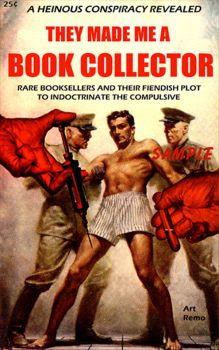
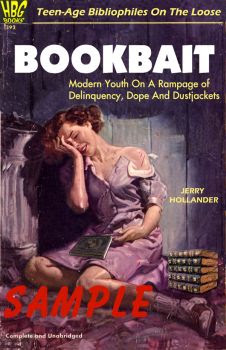
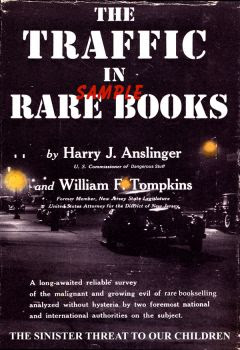
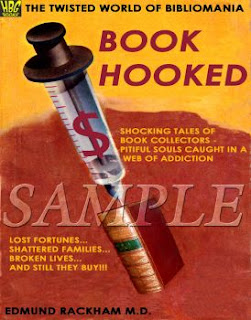
It's a tale told through posters designed and exclusively distributed by Heldfond Gallery Ltd in San Francisco, based upon vintage pulp fiction book covers. Proprietor Eric Heldfond has been  peddling them for a few years now, leaning against a lamppost on a dark street corner to tempt unwary passersby. I've succumbed to his evil pitch, bought a few, have given them as gifts, and suspect you may wish to do same for friends of dubious character, i.e. book lovin' broads, momzers, and biblio-debauchees - in short, fellow travelers in the shadowland of the sordid habit we call reading. Make yourself at home in the flophouse of the hopelessly hooked: Your local rare book shop.


Never before has the finger of light shone so glaringly on the wasteland of the book collector to pitilessly strip bare this seamy hotbed of unbridled text! 

 "Read any good books lately?" she purred. 
The dame had me right where she wanted me. 
I felt her scan my lines and before I knew it she tore 
off my jacket, and began to paraphrase my favorite part.
She bookmarked me, and how. I didn't complain.
I was a book junkie and there was no escape from this sinister paradise.
 __________

The posters are 8.5 X 11 inches, printed on 68lb. (252 g/mf) / 10.4 mil. heavyweight Premium High Gloss photo media.92 ISO, and priced at $25 each. Custom sizes up to 13 x 19 inches are available. Visit Heldfond's Bibliopulp gallery here.
__________
 
Originally appeared on Jume 14, 2010.
__________
__________

The Year Of Reading Dangerously

$
0
0
by Stephen J. Gertz

2012 provided many opportunities for daredevil readers to dance on the precipice and laugh in the face of peril. Here's a review of some of my own action-packed adventures in reading during the last twelve months.


I love beach reading; I can get lost in a book for hours, days, weeks. Aside from the risk to steady employment the only real danger is sand in the perineum and gutter margin. 


During 2012's hurricane season, however, a new menace manifested itself, emerging from the waves to scare the sand out of my shorts on the East Coast. Fortunately, the rest of my clothes were on the West Coast with me in them.


The book I was reading before and later while fleeing my Fruit of the Looms, a copy of Joseph Conrad's Heart of Darkness, was snatched from my hands on the run. Yes, I ran on my hands, my legs herky-jerky. When last seen Godzilla was reading the book aloud to a sacrificial victim, taking particular relish in reciting Kurtz's last words, "The horror! The horror!" followed by a diabolical laugh.


My ol' buddy from Hebrew school, Kim Jong-un (we called him Kim Jong-Junior, The Bane of Jehovah) was finally promoted to the rank of Marshal of the DPRK in the Korean People's Army on July 18, 2012, consolidating his position as the supreme commander of the North Korean armed forces.  When he isn't waving or saluting at something he enjoys reading Playboy to the exclusion of all other skin mags; he has, in fact, banned the competition.

Remembering, however, his keen sense of humor (a fellow frat-member died of laughter while listening to North Korean knock-knock jokes; an insidious form of torture), I dared to peruse Naked Pyongyang: 1,000 Flowers Of Joy, a sous le manteau guide book to the North Korean capitol's fleshpots, featuring Miss Anti-Yankee Imperialist July in all her glory, during his promotion ceremony.

Bad idea. When you're First Secretary of the Workers' Party of Korea, the Chairman of the Central Military Commission, First Chairman of the National Defense Commission of North Korea, the Supreme Commander of the Korean People's Army, and a presidium member of the Central Politburo of the Workers' Party of Korea, friendship, evidently, takes a back seat to foreign policy.

He fired a test ICBM at me - but not before ripping Naked Pyongyang from my hot little hands and stuffing it into his back pocket for later inspection of counter-revolutionary propaganda mercilessly exposing the North Korean body politic.


When Toyota recalled 7.43 million automobiles in 2012 due to power window problems that might cause a conflagration, Mom and Pop accidentally (?) left me in the car at the service center, where, after the window issue was corrected, my manifold pressure was adjusted, rings lubed, oil transfused, umbilical cord severed, and idle set. But a dedicated reader is never idle; I read A Duck, A Dog, And A Dipstick, the new childrens' book by Tom and Ray Magliozzi, "Click and Clack" of Car Talk fame, and the follow-up to their As The Wrench Turns. What's the danger? You try reading while your seat is reupholstered with an oil rag instead of a diaper, hot jumper-cables fastened to your 'jammies.


I'd often wondered what would happen if, while enjoying a leisurely cruise through the Mediterranean on the Costa Concordia in January 2012, I read Athanasius Kircher's massive two-volume folio, Mundus Subterraneus (1664-65) by the rail on the starboard side of the ship. Unless someone is simultaneously reading the same book on the port side I don't recommend it.


I had nothing better to do in October so I hopped a capsule, zoomed 31 kilometers into the stratosphere, and jumped. It only took eleven minutes to land but it felt like an eternity. Luckily, I brought a book along to pass the time; simply twiddling my thumbs would surely not allay ennui on the way down.


Plummeting toward Earth at  614 mph broke Evelyn Woods' speed-reading record but made reading a copy of Great Expectations a bit dicey - the wind-shear ripped the leaves out every time I tried to turn a page. It was originally a serial novel so it was fortunate that I'd eaten my Wheaties - The Breakfast of Champions -  that morning: you try holding onto a book and pulling a ripcord while you tear through the atmosphere like a human meteor.


The tragedy at Newtown led the National Rifle Association to assert that more guns are needed to protect ourselves and our loved ones from crazies with Colts or Bushmasters; they're all over the place. Taking the warning to its logical conclusion, the American Book Association now recommends that readers pack heat. In a further move, it has suggested that in the future all books be sold with guns n' ammo for readers' safety. This cross-marketing scheme will surely shoot book sales into  the ionosphere, so I'm all for it. The idea has the additional benefit of discouraging people from interrupting you while you're deep into text. For this reason alone, Good Housekeeping has given the notion its Seal of Approval. Lock 'N Load To Rock 'N Read is the NRA's proposed slogan.


My last act of book daredevilry occurred at 12:00:01 AM, January 1, 2013 when I dove off the fiscal cliff while reading economist and philosopher Friedrich von Hayek's The Road To Serfdom. The suicidal aspect of cliff-diving (and reading Hayek. If  Salma Hayek wrote it, 'nother story) fell into high relief as I fell to an uncertain end. Reading cuts without increases in revenue to lower the reading deficit is a recipe for literacy disaster.

That was My Year In Reading. Yours?
__________
__________

Educate! Amuse! In Color! The George M. Fox Collection of Children’s Books

$
0
0

by Alastair M. Johnston


There’s another children’s book show at San Francisco Public Library (through March 10th 2013), but this is the first since 1986 to draw on the library’s own superb resource: the George M. Fox Collection of Children’s Books.

The collecting of children’s books is a relatively modern phenomenon. There are great collections at Princeton (Cotsen Collection), in Toronto (Osborne Collection), Oxford (Opie Collection), UCLA, NYPL (Schatzki Collection) and in Florida (the Baldwin Library), that I know of, but the Fox Collection is remarkable, not only for its breadth but also for the condition of the books.

George Fox Sr was an executive at Milton Bradley and when they acquired the publishing firm of McLoughlin Brothers of New York, they didn’t want the firm’s archives and decided to dump them. Fox & another executive split them. The archives contained file copies of all their publications including a large cache of books by British publishers that were sent to them for consideration for republishing (or they may have been acquired to see what the competition was up to and ultimately to pirate them). They also contained the original woodblocks for some books as well as related ephemera. The original artwork that survived is at the American Antiquarian Society in Worcester, Mass. Fox added to the collection and gave over 2000 children’s books to the library in 1978. The current exhibition (the first since 1978) features over eighty examples of 19th-century color printing, especially color wood engraving and chromolithographs. Early hand-colored images are included as well. Highlights include “toy” and “moveable” books; work from the shop of Edmund Evans (who published all of Kate Greenaway's works) and many examples of fine British chromolithography from the firms of Thomas Nelson & Sons, Frederick Warne, Dean & Son and George Routledge & Sons.

McLoughlin Brothers’ motto “Educate and Amuse” marks an important turning point because, prior to the mid-nineteenth century, children’s books tended to be rather tedious and more about indoctrinating kids in good behavior than having fun. Catherine Sinclair’s Holiday House, 1839, is generally considered the first book written for children that does not have a built-in guilt-trip.

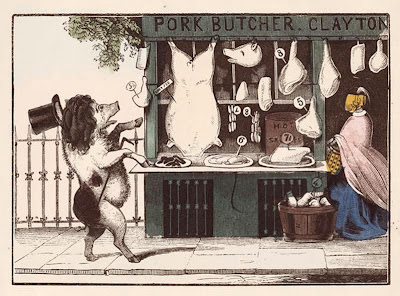
Tastes change over time also. The British books in the collection are sometimes marked up with alterations for the American market, or editorial comments. The Little Pig’s Ramble from Home, which is a personal favorite, has “Not much liked, very ordinary,” penciled on it. This is one of the titles that has survived elsewhere too and the Baldwin copy can be read on line at the childrenslibrary.org. In The Little Pig’s Ramble, Jack Pig puts on airs (a wig and top hat) and sets off to explore the world, only to be confronted with a pork butcher! Moral: Stay home if you know what’s good for you!

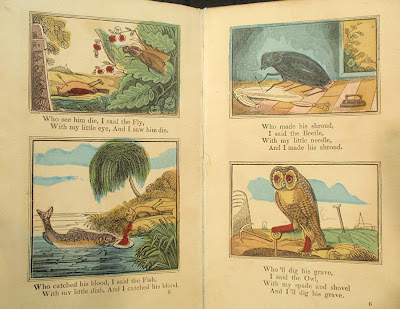
The books were often published in uniform series like “Uncle Buncle’s” or “Grandmama Easy's” and if the title was well-known it might generate sequels, as Ruth McGurk pointed out in her essay on the Fox Collection: “They are shameless in putting out sequels The Cock Robin story is spun into The Sad Fate of Cock Robin, Sick Robin and his Kind, Nurse Jenny Wren, Death & Burial of Cock Robin, Cock Robin Alive & Well Again and Mrs Dove’s Party. In the latter the guilty sparrow is punished by social ostracism.
And though he hopped in quite bold and undaunted,
He found not a bird that in kindness would greet him.”

He shoulda stayed in Las Vegas. Above is a spread from an 1850s book with hand-colored wood engravings: Mama Lovechild’s [sic] Life & Death of Cock Robin, published by McLoughlin Bros in New York from stereotyped plates.


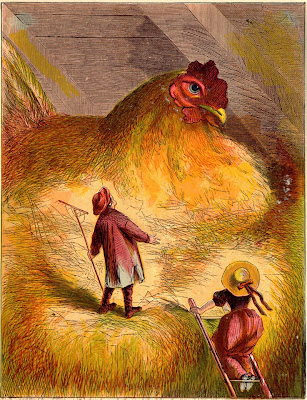
Not on display is a personal favorite: the giant hen in Learning to Count: One, Two, Buckle my Shoe (by Augustus Hoppin, New York, Hurd & Houghton, ca 1870), but it is in the collection should you choose to explore it.


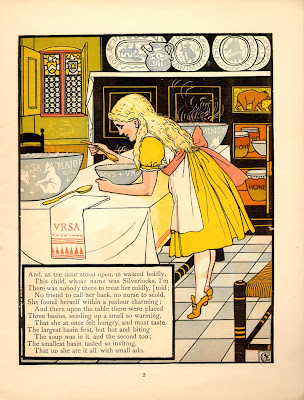
The books were advertised as cheap, colorful (some printed in ten colors) and above all avoiding vulgar sentiments. The big guns of children’s book illustration, Randolph Caldecott, Kate Greenaway and Walter Crane emerged in the late Victorian era and are well-represented in the collection. There’s even a Caldecott sketch “in the style of Greenaway.” As McGurk pointed out, “Walter Crane has a bent for whimsical detail.” She points out the Wedgwood bowls in the Three Bears rather luxe kitchen, labeled “Ursus Major, Ursus Minor, and Ursus Minimus”! Caldecott also wrote to Scribner's (who legally imported his books) complaining about the garish colors in the pirated editions of his books from McLoughlin and warning readers not to accept the cheap knock-offs.


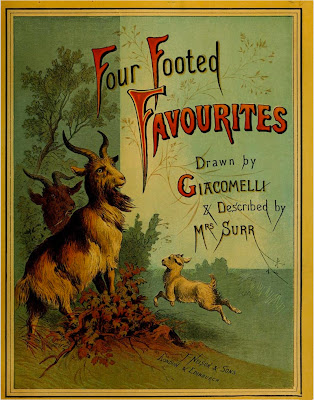
Short but sweet, Four Footed Favourites by Mrs Surr, published by Nelson & Sons in London, and illustrated by Hector Giacomelli, appeared in the 1880s. The recently digitized SFPL copy can be read on the Internet Archive site.


The SFPL copy of Comic Insects is also found there. It has anthropomorphism reminiscent of Tenniel’s Caterpillar in Alice (and of course Grandville), but above all it has spectacular color printing from chromolithography, including gold (above, which is very tricky to achieve). Published by Frederick Warne, ca 1872, it was written by the Rev F A S Reid, illustrated by Berry F Berry, engraved by Dalziel Brothers and printed from plates made by Kronheim & Co.


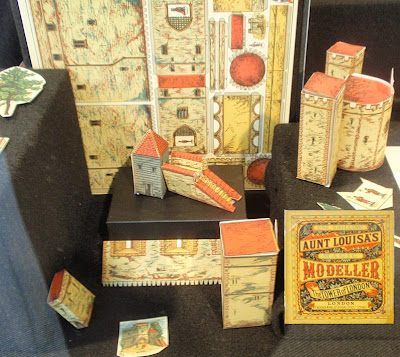
Aunt Louisa’s Magic Modeller (London: Frederick Warne & Co., ca 1881) is a paper toy you cut out to build a replica of the Tower of London. These paper toys were very popular in France & Germany also and make the child a participant in the project rather than a proprietor.


More elaborate toy books include Six Mysterious Pictures from Chaos: affording great amusement and intense surprise among children and their little friends (London: Dean & Sons, ca 1878). Such moveable books inspired the Surrealists in their game of Exquisite Corpse. The show is edifying, and also amusing.

Laura E. Wasowicz, Curator of Children's Literature from the American Antiquarian Society, will discuss the history of McLoughlin Brothers (1858–1950), and their role as producers of color picture books in America. The lecture will be held in the Koret Auditorium of the Main Library, on Saturday, January 5th, at 2 p.m.
__________

Of Related Interest:

Draw Me A Story: Collecting Children's Book Illustrations.

A Movable Book Feast: The World's Greatest Collection Comes To Auction.

Movable Books Pop Up At Smithsonian.

Dean & Son Movable Books and How To Date Them.
__________
__________

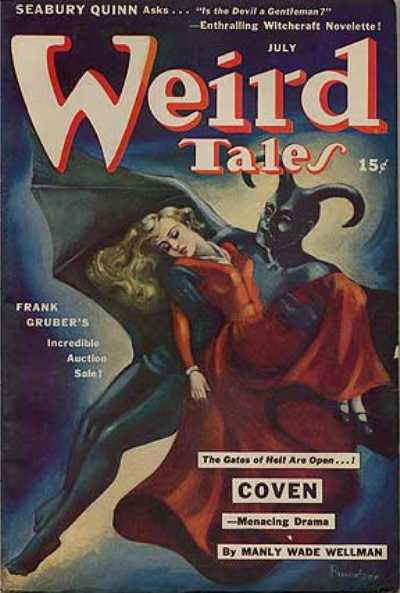
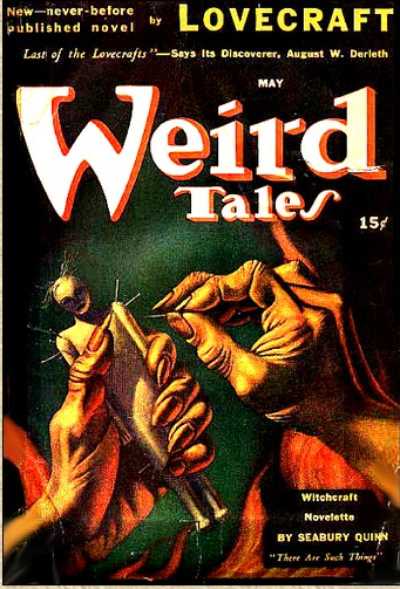
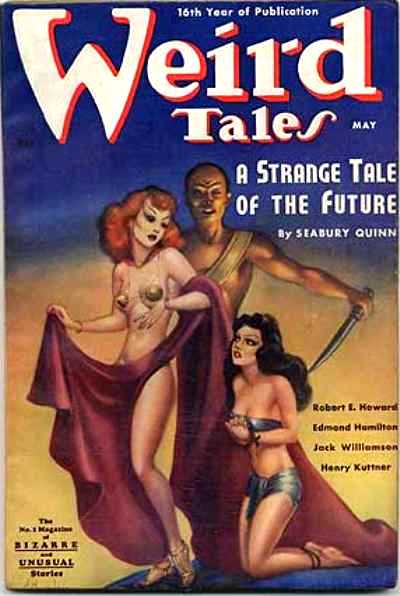
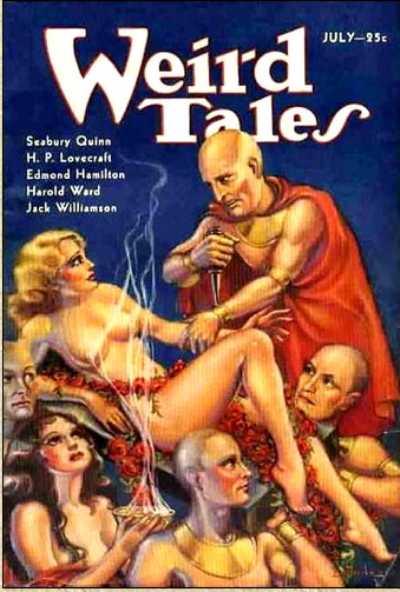
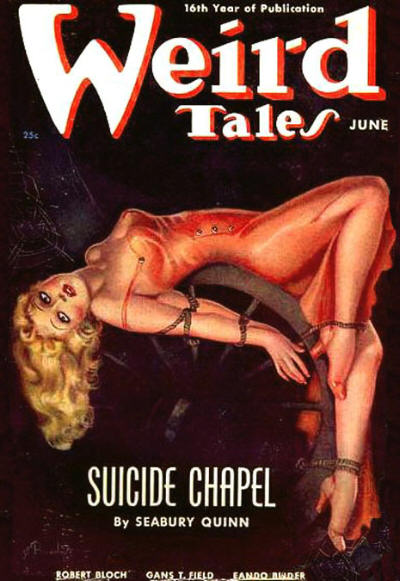
The Amazing John Martin Collection Of H.P. Lovecraft In Weird Tales

$
0
0
by Stephen J. Gertz

March 1938.
First Weird Tales appearance of Lovecraft's
Beyond the Wall of Sleep.
Cover art by Margaret Brundage.

John K, Martin is, perhaps, best known as the far-sighted founder and publisher of Black Sparrow Press who fostered Charles Bukowski's career as patron and publisher. For that alone he has entered literary history. Yet few are aware that Martin has also been one of the great book collectors of our time. Now 82 years old, John has put his superlative collection of H.P. Lovecraft in Weird Tales, the famed pulp magazine, up for sale.

A remarkable collection of eighty gorgeous issues amassed over decades, each - incredibly -  is in fine to very fine condition with yapp edges intact; these old pulps are usually  encountered in rubbed, sunned, toned, and torn shape.

We recently had an opportunity to talk to John Martin about the collection.

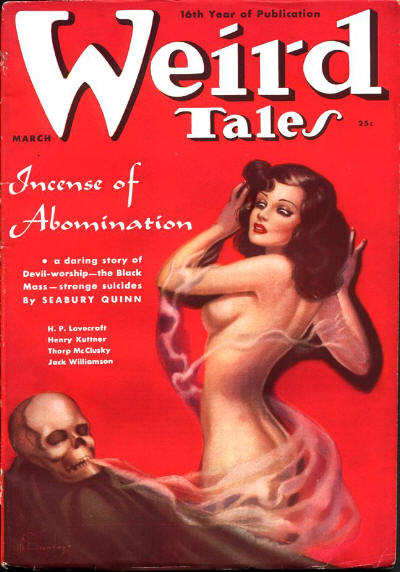
March 1937.
Contains Lovecraft's The Picture in the House.
Cover art by Margaret Brundage.

BT: When did you start collecting the pulps?

JKM: I began collecting books in general in 1950 when I was 20. At that time I was attracted to both Lovecraft and the pulps that published him. Over the years I collected and then disbursed many Lovecraft items, often in trades. About 15 years ago I decided to collect Lovecraft seriously once again, and to concentrate on the pulps, pamphlets, fanzines, leaflets, etc.

BT: Each copy in the collection is in Fine condition. Were you always aware of condition when you first began to collect them? (Not something young collectors generally pay attention to).

JKM: I learned very quickly that pulps and first editions in poor or average condition were not worth the time and money it took to collect them. That fine copies were essential. Also, I took more pleasure in holding and reading the individual items if they were in the same, or nearly the same, condition as when they were published. Somehow it turned back the clock for me to the time of first publication.

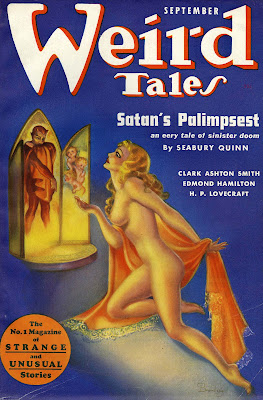
September 1937.
First Weird Tales appearance of Lovecraft's poem,
Psychopomos.
Cover art by Margaret Brundage.

BT: When you began was it your intent to seriously collect or did it sort of snowball from informal to committed?

JKM: I was a serious collector from day one but I didn't begin to put together this current Lovecraft collection until about 1995.

BT: Weird Tales exclusively or others as well?

JKM: As per above (#1), I collected Weird Tales plus every Lovecraft periodical publication I could find published up until c. 1940 (of which there are hundreds). Some are so fragile (and rare) they almost disintegrate in your hands.

July 1942.
First Weird Tales appearance of Lovecraft's
Herbert West: Reanimator, Part 2. The Plague Demon.
Cover art by Margaret Brundage.

BT: Was H.P. Lovecraft your area of interest and  Weird Tales followed?

JKM: Then and now, my first interest was Lovecraft, followed by a desire to collect the first edition of everything he ever wrote.

BT: Where did you find the stuff?

JKM: In the early days, copies of Weird Tales could be found in used magazine stores and some bookstores for 25 cents apiece. Since I began this current collection in 1995, I was able to utilize the internet. Also I was able to go back to several dealers from whom I had purchased Lovecraft material in earlier times.

The prices for Lovecraft material (and most literary first editions) have ballooned beyond all reason. It's a prime example of hyper-inflation. A 1920s fine copy of Weird Tales with a Lovecraft contribution, can cost from $1500 to $5000, or more in a few cases.

May 1941.
First appearance of Part One of Lovecraft's
The Case of Charles Dexter Ward.
Adapted to film by Roger Corman in 1963
as The Haunted Palace.
Cover art by Hannes Bok.

BT: Why Lovecraft?

JKM: As an impressionable, unsophisticated 20 year old, I read a story called "The Doom That Came to Sarnath." I was hooked. (It took me more than 50 years to find a copy of the June 1920 issue of "The Scot" where this story first appeared.)

BT: Favorite Lovecraft in Weird Tales?

JKM: "The Doom That Came to Sarnath" remains my favorite Lovecraft story. (It was reprinted in the June 1938 issue of Weird Tales.
BT:  Have you collected Lovecraft beyond Weird Tales, i.e. Arkham House, etc.?

JKM: I collected the two books what were printed before Lovecraft's death, "The Shunned House" (1928) and "The Shadow Over Innsmouth" (1936).

October 1937.
First appearance in Weird Tales of Lovecraft's
The Shunned House.
Cover art by Margaret Brundage.

BT: You're known for your collection of D.H. Lawrence as well? What other collections have you put together? Is there an underlying theme that unites them in some way?

JKM: I have spent the past 62 years assembling author collection. I sold my D.H. Lawrence collection (that took me 40 years to build) a few years ago. I believe at the time it was by far the moist extensive private holding of Lawrence's first editions, manuscripts, letters, artworks, photographs, and association items. Everything was in very fine condition.

Realizing that I am 82 years old and "can't take my books with me," I have also (along with Lovecraft) recently sold my author collections of Henry James, Theodore Dreiser, and Charles Bukowski. I still retain my collections of Ezra Pound, Henry Miller, A.E. Coppard, Saul Bellow and Bernard Malamud, along with several hundred miscellaneous first editions.

I still retain my collections of Ezra Pound, Henry Miller, A.E. Coppard, Saul Bellow and Bernard Malamud, along with several hundred miscellaneous first editions.

May 1938.
First appearance of Lovecraft's poem,
In a Sequestered Churchyard Where Once Poe Walked.
Also first appearance of Robert E. Howard's story, Pigeons From Hell,
which Stephen King called one of the best short stories of the 20th century.
Cover art by Margaret Brundage.

 BT: Any particular reason why you're still holding on to those authors?

JKM: I am not exactly "holding on." I just haven't gotten around to offering them for sale. Also, I MUST be surrounded by books or I'll curl up and die. Also, I LOVE reading these authors over and over. (I think I have read every book I ever bought.).

BT:  After collecting for 62 years do you have any regrets about a book that got away, something sought but never found and acquired, a Holy Grail?

JKM: I never was able to buy a first edition of "Leaves of Grass." Ditto Pound's first book, "A Lume Spento." Ditto, "Sons and Lovers" in a first state dust jacket. My only three big regrets.

July 1933.
First appearances of Lovecraft's
The Dreams of the Witch House and
The Horror in the Museum.
Cover by Margaret Brundage.

BT:  You began collecting when legwork ruled, before the Internet brought the marketplace into collectors' homes, Any thoughts on the difference in experience?

JKM: The difference between collecting books the old fashioned way vs. collecting books over the internet, is the difference between swimming from New York to London or taking a jet.

BT:  Finally, your thoughts on Weird Tales cover art, so many by the great Margaret Brundage?

JKM: You'd have to be blind not to love the Weird Tales covers. Especially the ones from the 1920s and 1930s.

June 1938.
First Weird Tales appearance of Lovecraft's The Doom That Came To Sarnath.
Cover art by Margaret Brundage.
__________

All images courtesy of Between the Covers, currently offering this collection, with our thanks.
__________
__________
Travels with Kapuscinski, Travel Writer Extraordinaire

$
0
0

by Alastair M. Johnston


Ryszard Kapuscinski: a Life, by Artur Domoslawski, Verso, 2012, 456 pp., cloth in d.j.


You know who makes my blood boil? Rick Steves, the twerp with a travel show on American public television. A TV crew follows him around Europe while he stumbles into local museums and fancy hotels with a yokelish manner that yells, Look out natives, it's those culturally deprived Yankees again! He thinks if someone doesn't understand him all he has to do is raise his voice. After all if they don't understand English they should. Well, I suppose there's an audience for his banal brand of travel.

I am more of the adventure travel type: I've been lost in the Nubian desert, pursued by armed bandits in Southern Sudan, attended a Candomblé ceremony in the slums of Brazil (with fireworks to get the Gods' attention), and got so disoriented at a Voodoo ritual in Port-au-Prince that I wandered lost in the backstreets of the Haitian capital half the night until I found the sanctuary of the Oloffson hotel. In my teens I was held at the Bulgarian border, suspected of being an Anarchist because I had long hair. I was freed after a humiliating haircut done with tiny surgical scissors that left long wisps and bald spots, giving me even more of the air of an escaped lunatic. A Sikh man wept as they cut off his beard.

So my kind of travel journalist is always coming across armed roadblocks in the Third World and thinking he is about to get blown away.
"I was waiting for them to set me on fire... I felt an animal fear, a fear that struck me with paralysis ... My life was going to end in inhuman torment." (The Soccer War, pp. 133-4)

Ryszard Kapuscinski is my kind of writer, coming from a tradition that connects Orwell and Marquez. He travels to unusual locales with a purpose: to report on a revolution or insurrection, and while I wouldn't intentionally go into a war zone, it's thrilling to read about it. Like him, I contracted malaria in Africa, and, like him, felt it was the price to pay for the incredible experiences I had there. For years I would scour Granta magazine looking for pieces by Kapuskinski while waiting for an addition to his slim shelf of books (there are but seven of his cultural travelogues). I got the news he had died from the dustjacket of Travels with Herodotus (2004), and it was a sad blow.

Ryszard Kapuscinski was born in 1932 in Pinsk, which was in Eastern Poland then. After the Nazis invaded and killed the Jewish population, the Red army took possession and it became part of Belarus. Kapuscinski had a mother who idolized him and a father who didn't understand him. When his father saw him sitting up late, reading and underlining a book, he told his son: Go to bed, son, by morning I will have underlined the entire thing for you.

But that is later: during the War the father was about to be deported to Siberia so fled to German-occupied Poland and joined the Resistance. Maria, his wife, and children followed — out of the frying pan into the fire. Young Ryszard, 7 years old, experienced terror, poverty and hunger. The War was horrific but he survived by blending in, not trying to be a hero. He was a good Catholic, then a good Communist. So, the author asks, is this how he survived in all his fantastic adventures as an adult? Is the real Ryszard just a writer creating the mythic Ryszard in books about wars & revolutions in Angola, Congo, Iran, Ethiopia and Latin America?

The central question at the core of any biography is, Who was this person? Kapuscinski was a reporter and therefore a good listener and observer. Even those who seemingly were his closest friends only remember him listening. The book is a series of "snapshots," but they are as enigmatic as the close-up of that Polish face with a cigarette and querying eyes, scrutinizing the reader from the front cover.

RK grew up in a Totalitarian system. The way to survive is to keep secrets, to lie constantly, to reinvent oneself. We must not judge people who lived through the War and Stalinism: they did what was necessary. RK was a party member, a keen one; but calling him a "collaborator" is pointless. He was a youth activist, a reporter and a poet. His literary activities were in line with party orthodoxy. Revolutionary propaganda was second nature to him, so it is interesting that we know him as a reporter seemingly outside all the revolutions he witnessed and wrote about in his magisterial works. However one reason the state machines of Iran, Latin America and Ethiopia were so familiar was that he could have been writing about home.

1956 was the year of a great thaw in Poland, a turning point in its history: A youth festival attended by hundreds of thousands of young people saw an influx of Western Europeans who brought jazz, cool colorful clothes and an eagerness to get it on. People were becoming more critical of the regime and changes began to occur. There was still censorship but the truth began to seep out. RK began his career as a foreign correspondent and consequently would miss most of the changes that occurred in his homeland, but he preferred life on the road to being behind a desk.

His first foreign assignment was India (he writes about it in his last book Travels with Herodotus): throwing off the yoke of colonialism meant a lot of countries were turning to the Soviet bloc for ideas, for support and materials; so he also went to China, but cut short a side-trip to Japan when he had to resign from his paper in solidarity with the other reporters who had walked out. His passion for the Third World was stoked and his anti-colonial outlook meant he would become more than a journalist covering politics abroad: he would become an interpreter of cultures.

But while many of us go in search of the exotic, this is not RK's aim:
"The so-called exotic has never fascinated me, even though I came to spend more than a dozen years in a world that is exotic by definition. I did not write about hunting crocodiles or head-hunters although I admit they are interesting subjects. I discovered instead a different reality, one that attracted me more than expeditions to the villages of witch doctors or wild animal reserves. A new Africa was being born — and this was not a figure of speech nor a platitude from an editorial. The hour of its birth was sometimes dramatic and painful, sometimes enjoyable and jubilant; it was always different (from our point of view) from anything we had known, and it was exactly this difference that struck me as new, as the previously undescribed, as the exotic." (The Soccer War, p. 21)

Kapuskinski identified with Africans' struggle under colonialism, but Africans found it hard to believe that whites had colonized other whites, just as they found it hard to understand him when he talked about tramcars or snow. Snow recurs in his work, especially in a wonderful passage about frozen corridors in the mist found in Imperium which can be reread like parts of Dickens, proving ultimately that Kapuskinski is a sensual rather than an intellectual writer. 

He interviews 10-year-old Tanya in Yakutsk:
"One can recognize a great cold, she explains to me, by the bright, shining mist that hangs in the air. When a person walks, a corridor forms in the mist. The corridor has the shape of that person's silhouette. The person passes, but the corridor remains, immobile in the mist. A large man makes a huge corridor, and a small child — a small corridor… Walking out in the morning, Tanya can tell from these corridors whether her girlfriends have already gone to school…
   "If in the morning there are no corridors that correspond to the stature of students from the elementary school, it means that the cold is so great that classes have been canceled and the children are staying home.
   "Sometimes one sees a corridor that is very crooked and then abruptly stops. It means — Tanya lowers her voice — that some drunk was walking, tripped, and fell. In a great cold, drunks frequently freeze to death. Then such a corridor looks like a dead-end street."

But Kapuscinski was known for embroidering his tales and although his friends took his stories with a pinch of salt, he invented a gonzo persona for himself: the death-defying journalist who faced firing squads without flinching and was lucky when someone bought off the commandant with liquor, etc etc. The problem is, according to his biographer, Ryszard began to believe these myths too.

After witnessing the tragic collapse of the revolution in Congo in 1960, RK wrote cynically about the prospects for the nascent state in which the "most backward country in Africa came under the control of the most worthless, insignificant people in Europe" (Belgium) and was carved up by imperialist Western powers, notably the USA. His reports in the press raised nearly 3 million zloty for the Lumumba Fund in Poland. In 1962 RK became the only foreign correspondent of the Polish Press Agency and the whole world became his beat. It really sounds like a classic Polish joke: How many Polish reporters does it take to cover the foreign beat? One.

But that one is astonishing. He witnessed 27 revolutions, civil wars or coups d'etat. He thought it was good to know two or three languages but carried on learning until he knew seven or more. This helped him in Angola and even Gdansk. His African reports are published as "Special bulletins" by the Polish Press Agency, which means high-ranking party officials can read them but their candid analysis of affairs cannot receive wide circulation in the daily press. This puts him in a privileged position: he can speak his mind, but then knows his work is not reaching the widest audience. But these were not all political or economic reports, RK took a delight in meeting everyday people and writing about them. His boss loved his style so didn't chide him when he vanished for weeks on end or turned in short pieces. He used his skill brilliantly. When he was sent to Russia to cover the 50th anniversary of the October Revolution in 1967, "he writes from the viewpoint of a man who is surprised. This permits him to tell us things about the Soviet system that he couldn't say in any other way. It's a masterpiece — to write so much truth without necessarily being critical. The wolf is fed, and the sheep is still in one piece."

Off to Chile he hears rumors of a coup and sends them home in a not-for-publication special bulletin, but the header gets lost and his article appears on the front page of a daily paper. Salvador Allende looks out for him so instead of arrest he is only deported to Brazil.

Book jackets always refer to him meeting Che Guevara and Patrice Lumumba but that is not true: however he never corrected those statements. He didn't have to lie — he was RK, but obviously, Domoslawski thinks, he lacked self-confidence.

What we learn from RK's work is that there is no such thing as objective reporting. He tries to give both viewpoints but you can always see where his sympathies lie. In Angola he gets the story of a lifetime. The Cubans have sent military advisers to the MPLA. This is a bombshell, but how does he know? Well, the Cubans are operating via Russian intermediaries and the only person who speaks Spanish, Portuguese and Russian is Kapuskinski, so he is drafted into the meetings to interpret! He is sitting there as a civil war is being hatched, but he cannot do anything about it. If he fires off a telegram to Warsaw as a "Special Bulletin" it might get intercepted; if the news leaks out then the Western powers may send in their troops. Clearly his sympathies were with the Marxists and that was more important than getting the scoop.

Africans are sometimes critical of his writing on Africa as simplistic, and borderline racist, but he has a passion that ignites his prose, and reminds us of the passion Germans in the 19th century had for the American Indian. Far from being objective he even takes up arms when he is with the MPLA at the front and caught in a firefight.

Back in Poland Socialism has evolved into consumerism, with money borrowed from the West, but the government is crumbling. RK writes his great book, The Emperor, ostensibly about the fall of Haile Selassie of Ethiopia, but as it appears weekly people start to read it as an allegory about the corrupt "court" of Gierek, Poland's lax ruler. One reviewer says it's as if Kafka had written The Castle from inside the keep. The censors are afraid to touch it because that will show they really feel there is something to the fabled parallels between their own collapsing bureaucracy and Selassie's.

Poland changes; the Solidarity movement breaks out in the shipyards and Kapuskinski is sent to cover it, and of course writes the best reports, not covering Walesa's speeches so much as talking to the ordinary striking workers, many of whom are passing the time by reading his books! But Walesa inspires him and he sides against the government, losing his job. However his books have been translated and he is able to leave Poland and travel to Europe and the United States as a speaker. But all reports are that he is not very good on the podium: even as a teacher of journalism, his students expect him to regale them with anecdotes about Che Guevara, instead he discusses the finer points of Latin American Marxist theory. (As a former Catholic he was drawn to "liberation theology.")

And there are the famous missing pages (15 of them) from the American edition of Shah of Shahs, which discuss the CIA's role in the Iranian revolution and the overthrow of Mosaddegh in 1953. Domoslawski can find no evidence of any American editor asking for the cuts: only RK himself could have censored his own writing: perhaps he knew that although he was always a fierce critic of Yankee Imperialism he would be looking to America for prizes, awards and lectureships and so better retract his fangs a bit. Or perhaps he was afraid the CIA had files on him and could expose his role in providing information on Americans to his own secret service.

But one searing truth is, Kapuskinski couldn't handle criticism and was always taken aback by fact-checkers who critiqued his works on Iran and Ethiopia. He was creating a new kind of literature: a fictionalized reportage that has all the elements of truth but which are configured in a way to suit the author rather than reality. You might say it's magic realism applied to journalism as seen, for example, in the works of Bruce Chatwin. Rather than magic realism, Domoslawski calls it "tropical baroque."

At the end of his life, RK wrote out a quote from Mircea Eliade's diary: "My best books will be written by someone else." He had abandoned the third in his "power" trilogy — a biography of Idi Amin — to rush through Russia after perestroika and write Imperium, his masterful account of the collapse of the Soviet Union. He wanted to write a summing up of all his thoughts on Latin America in a book called Fiesta, but set that aside when he decided to retrace Bernard Malinowski's steps to the Trobriand Islands and write about that instead, one of the last "uncivilized" places on earth, but he became too ill.

He left behind a globe on his desk and on each continent were posted notes:
North America: community
South America: trust
Eurasia: Inquiring nature, openness, joy, friendship, sympathy, hope
Australia: no comments
Africa: LOVE
__________
__________

Two Scarce Erotic Novels From 1787 Exposed (May Be NSW)

$
0
0
by Stephen J. Gertz


A couple of extremely rare erotic books recently came into the marketplace, wowsers both, each from the eighteenth century and scarcely seen but when seen goggle eyes and boggle mind.

Mémoires de Saturnin (1787), is one of the best of the many reprints of Histoire de Dom B***, Portier des Chartreux by lawyer Jean-Charles Gervaise de Latouche (1715-1782); “one of the most celebrated French erotic novels of the 18th century” (Kearney). It is the most important erotic novel in the period immediately prior to Cleland's Memoirs of a Woman of Pleasure (1748) and one of the most frequently reprinted books of all erotic literature.


Originally published in 1741 in two editions (true first not firmly established) it has become an old warhorse, a classic anti-clerical erotic novel that under its original title went through seventeen editions  between 1741 and 1960.

"Saturnin" is the surname of the protagonist, Dom Bourge, "the fruit of the incontinence of the reverend Celestine Father of the town of B," and a porter in the convent at Chartreux.  As you might expect from  a so surnamed person, saturnalias ensue. "My heart is agitated - is it through fear that I shall be reproached with revealing the mysteries of the Church? Alas! I must overcome this compunction. Who does not know that all men are men, and especially the monks? they have certainly the faculty of cooperating in the propagation of the species; and why should we hinder them…?"

Why stop there? The biblical story of Sodom is considered  slanderous to homosexual activity, which gets a workout satisfying to all concerned. The book was banned not so much for its pornographic nature as its  anti-religious aspects, a greater threat to civilization than indecency.


Patrick J. Kearney notes seven editions 1772-1946 under the title Histoire de Gouberdom; three as Histoire de Saturnin; twenty-three as Le Portier des chartreux 1784-1954; five editions 1787-1815 titled Memoires de Saturnin; and eight English editions 1743-1930. Most may be aware of the novel as published by Maurice Girodias' Ophelia Press in 1958 under the title The Life and Adventures of Father Silas by Beauregard de Farniete, apparently a reprint of the London 1907 (i.e. Paris: Charles Hirsch, 1910) English edition with the same title. During the 1960s, a slew of paperback reprints based upon the Ophelia Press edition was issued under various titles by American pornsters. There are undoubtedly editions that have yet to be recorded. Mr. Kearney's checklist is the most complete to date.

The edition under notice is one of the most highly desirable, with twenty-four unsigned engraved plates by François Rolland Elluin after designs by Antoine Borel. It was anonymously published in Paris by Cazin in 1787 as two parts in one book, in octavo and 18mo issues. The volume under notice is one of only three known large paper octavo copies.


“C’est la plus belle edition que l’on puisse trouver de ce roman érotique et l’une des plus réussies dans les productions de Cazin” (Cohen. “This edition is the most beautiful that you can find of this erotic novel and one of the most successful productions of Cazin”).

Of the engravings, Pascal Pia, in Les Livres de l’Enfer, notes “Les Meilleures que l'on ait faites pour illustrer ce classiques de l'érotisme” (“The best that have been made ​​to illustrate this classic of erotica”).


Publisher Hubert Martin Cazin (1724-1795 was the son of a bookseller in Reims, a trusted member of the community of booksellers and printers of the city.

He followed in his father’s profession but with a taste and clientele for prohibited books. As a result he was enjoined from bookselling in 1754. In 1784, he moved to Paris and began his career as a publisher.

Cazin editions were, and remain, highly regarded for their production quality and licentious character. For his efforts Cazin earned many fines and two involuntary vacations in the Bastille.


The anonymously written “by a sacrificer to Venus,” Les Heures de Paphos, was published in 1787 with four subsequent editions 1864-1875. The 1864 edition was anonymously issued by Auguste Poulet-Malassis in Brussels and falsely dated 1787. The 1872 edition was falsely dated 1787. The 1875 edition was falsely dated 1789.


The illustrations - twelve engraved plates plus frontispiece - are in the manner of Claude-Louis Desrais (1746-1816), painter, illustrator, engraver, and student of Italian painter, Francesco Casanova (Giacomo's younger brother). Desrais was particularly known for his gallant/erotic illustrations to contemporary novels.

Today’s post is false-dated 2013.  It was actually anonymously written in 2074 with false imprint Santa Monica-in-the-Sea, CA  (i.e. Ulan Bator: Mongol Art Editions).
__________

GERVAISE De LATOUCHE, Jean-Charles. Mémoires de Saturnin, écrits par lui-même. Nouvelle édition, corrigée & augmentée avec Figures. Premiêre [and] seconde partie. Londres [Paris]: n.p. [Cazin], 1787. Later edition, two parts in one volume. 235 pp. Twenty-four engraved plates by Elluin after Borel.

Pia 622. Dutel A-523. Cohen 431.

[DESRAIS, Claude-Louis, illustrator]. Les Heures de Paphos. Contes moraux par un sacrificateur de Venus. Paris: n.p., 1787. First edition, large paper. Octavo. 74 pp. Frontispiece and twelve engraved plates after Desrais.

Pia 611. Dutel A-496. Cohen 486.
__________

Illustrations courtesy of Camille Sourget Livres Anciens, currently offering these titles, with our thanks.

Title pages from Dutel, Bibliographie des Ouvrages Erotiques...1650-1880.
__________

Of Related Interest:

The Wages of Sin: : $80,000 For Rare Fanny Hill.

Hey Rare Book Guy! Is It Pornography, Erotica, or Curiosa? 
__________
__________

Fighting Modern Evils With Old Rare Books

$
0
0
by Stephen J. Gertz

MILLER, Fred S. Fighting Modern Evils That Destroy Our Homes
- A Startling Exposure of the Snares and Pitfals of the Social World
- Vividly Depicting How Homes Are Wrecked and Souls Destroyed
Through Wiles and Trickery of Mystic Cults.
N.P. [U.S. of Canada]: n.p. [the author], n.d. [c. 1913].

In the modern world each footfall is an opportunity to drop into an abyss and snowshoes won't prevent you from sinking into perdition. There is, however, a rich corpus of vintage self-help, instructional and inspirational literature to keep you from drowning in a pool of damnation.

Here's a small selection, from Old New Age, the latest catalog from David Mason Rare Books.

KRESS, Daniel H. The Cigarette.
As a Physician Sees It.
Mountain View, CA: Pacific Press Publ., [c. 1932].

Modern Evil #1: Cigarettes.

Pacific Press Publishers of Mountain View, California was a Seventh Day Adventist venture dedicated to educational titles on activities that lead to the road to ruin. Get your kicks on Route 666 and experience Hell Before Death.

Here, inside the Los Angeles Coliseum during the 1932 Olympic Games, the U.S. track team doc examines a runner prior to race time. Judging by the expression on the Olympian's face, he's just been diagnosed with Stage-3 lung cancer and congestive heart failure. Will he make it to the finish line?

Not too long after this pamphlet appeared, Big Tobacco would recruit doctors real or otherwise to endorse their products in advertisements, M.D.s who, apparently, had their fingers crossed when taking the Hippocratic Oath.

HORN, M[ildred]. A. Mother and Daughter.
A Digest for Women and Growing Girls,
Which Completely Covers the Field of Sex Hygiene.
Toronto: Canadian Hygienic Products Ltd, n.d. [c. 1940s].

Modern Evil #2: Reckless Teen Behavior.

Young girls - you know who you are - have you no shame? Want to find a good husband? Have children? Lead a long, wholesome life? Listen to your mother! She'll teach you all about the science of keeping clean, healthy, and happy! You'll be miserable but so what? Fun is over-rated.

HALE, Beatrice Forbes Robertson. What Women Want.
An Interpretation of the Feminist Movement.
New York: Frederick Stokes, (1914).

Modern Evil #3: Feminism.

Damned suffragettes were tearing the social fabric in America and England, the contemporary social fabric an easily stained synthetic silk with rough threads; good riddance. 

Actress, suffragist, prolific author and lecturer Beatrice Forbes-Robertson Hale (1883-1967), niece of J. Forbes Robertson,  the famed London actor and theater manager, was an ardent feminist who married young Wall Street lawyer Swinburne Hale in 1910. He was "won by her speeches…Young attorney began ardent courtship after hearing her espouse woman's cause" (NY Times, April 29, 1910)

"Miss Forbes-Robertson will not give up the stage nor abate her efforts on behalf of the woman suffrage cause after her marriage to Mr. Hale. She has been prominently connected with the campaign for woman suffrage in both England and in this country, where she has been of large service through her platform eloquence.

"She is a finished speaker, and though she has never become associated with the extreme militant suffragettes closely enough to accomplish arrest, she has done a great deal of platform work here and abroad" (Ibid).

The Hales divorced in 1920 and Beatrice returned home to England but continued to visit the United States and remained fully engaged in the women's rights movement.

Beatrice Forbes-Robertson Hale was, it seems, a bit naive about her sisters in the struggle. Margaret Sanger, in The Woman Rebel,  her law-challenging journal, wrote:

"Beatrice Forbes-Robertson Hale said at a debate on feminism that she knew of only two feminists who advocated free love and unmarried motherhood, and that they were not suffragists, but anarchists. What a limited knowledge of women Mrs. Hale has! Perhaps after all self respect and morality are confined to the anarchist women!"

What Women Want is a very rare book with only a handful of copies in institutional holdings worldwide. Read the full text here.

VOM BRUCH, Harry W. The Carnival of Death.
Or the Modern Dance and Other Amusements.
Mont Morris, IL: Kable Brothers Co., n.d. [c. late 1910s].

Modern Evil #4: Dancing.

Dancing had been viewed as sinful as far back as the eighteenth century but with the influx of single girls into the urban workforce the perils of the dance hall did a grand jeté into the evangelical congregation with jeremiads aplenty.

The tacit terpsichorean culprit in Carnival of Death is, I suspect, the Black Bottom, which originated in New Orleans in the first decade of the 20th century. Its roots in African-American culture made it Public Enemy #1 amongst the decline of the West set.

Am I alone in mourning the passing of dances with names? The Black Bottom, Charleston, Lindy Hop, Jitterbug, Mambo. Cha-Cha, Merengue, Rhumba, Bossa Nova, the Swim, the Frug, the Shing-a-ling, the Monkey, the Mashed Potatoes, Watusi, Hully-Gully, the Shake, the Twist, the Funky Chicken, Pony, the Loco-motion, the Freddy,  the Bump, the Hustle, Macarena - even those dreaded of all social-banquet dances, the Hokey-Pokey and the Bunny Hop: quick, what's the name of the latest dance of 2012-2013? The Whatever.

ELLESBY, James. A Caution Against Ill Company:
Or, a Discourse Shewing the Danger of
Conversing Familiarly With Bad Men.
London: F.C. & J. Rivington, 1812.
Tenth edition.

Modern Evil #5: Bad Men.

Reverend James Ellesby, author of The Sick Christian's Companion (1729) -  no smirking, please; the book is a selection of prayers to endure illness, not a guide for Christians of dubious turn of mind - here cautions against females engaging in casual social intercourse with bad men; it can lead to that other casual intercourse, you know, the one that leads to the streets. From hello to Hell is only one lost virtuous vowel away.

Come on, gals, 'fess-up. Bad men are catnip! This is why, only hours after my Bar Mitzvah, I immediately began riding Harleys without a license, using bad language, smoking, playing pool, hanging-out on street corners, staying up past my bedtime, and generally flouting authority so egregiously that I was routinely remanded by the court to my room without supper. In short, I became a chicklette-magnet, 11 and 12-year old vampettes vying for the attention of this older, thirteen year old man so incredibly wise, so astonishingly smart, so breathtakingly handsome, so overweeningly conceited, and desperate to become an excommunicated Boy Scout but too milquetoast for misdemeanors, much less felonies.

"He's irresistible. He treats me like crap. I'm in love!"

HARRIS, Rev. W.S.. Hell Before Death.
With Illustrations by Paul Krafft.
N.P.: (Luther Minter): n.d. [c. 1908].
By Subscription Only.

Modern Evil #6: Capitalism.

Hell Before Death author, Rev. W.S. Harris, "who has devoted many years in securing better conditions for humanity," writes:

"Under the whip of monopolistic slavemasters, the host of common people, generally known as laborers, are getting deeper into bondage…This movement on the part of Labor was perhaps the most fortunate thing that could have happened; for, if capitalistic oppression had continued unchecked for a few decades more, by this time, the nation would be owned and controlled by a few great moguls, and the great bulk of humanity would be reduced to a new type of slavery even more abject than the kind under which we now suffer" (from the Preface. Full text of Hell Before Death here).

Sure glad that didn't happen.

SOUTHARD, R.E. Problems of Decency.
(St. Louis): The Queen's Work, n.d. [c. 1949].

Modern Evil #7: Indecency.

The Catholic University of America library has 742 publications, pamphlets and magazines from The Queen's Work, a Jesuit publishing house based in St. Louis and the pioneer mass circulation magazine to popularize the Catholic faith.

It was founded and edited by Daniel Aloysius Lord, S.J. (1888-1955), a popular American Catholic writer. Lord became national director of the Sodality of Our Lady in 1926, also serving as editor of its publication, The Queen's Work magazine. He stepped down from editorship in 1948, but continued to write for the magazine for the remainder of his life, producing more than 500 pamphlets, plays, and songs.

In 1927, he served as a consultant to Cecil B. DeMille for his silent film, King of Kings. The advent of talkies alarmed him. "Silent smut had been bad," he would write in his autobiography, Played by Ear. "Vocal smut cried to the censors for vengeance."

In 1929, he began work on Hollywood's Production Code. "Here was a chance," he wrote, "to read morality and decency into mass recreation." He aimed "to tie the Ten Commandments in with the newest and most widespread form of entertainment," aspiring to an ecumenical standard of decency, so that "the follower of any religion, or any man of decent feeling and conviction, would read it and instantly agree."

In 1930, Lord's draft of the Code was accepted by Will H. Hays and promulgated to the studios with only minor changes, but it lacked an enforcement mechanism, and Lord came to consider it a failure. It was only with the mid-1934 advent of the Production Code Administration headed by Joseph Breen that the Code became the law of Hollywood for more than twenty-five years.

Clean up the movies? Sanitized for your protection? Mission accomplished!

GAYNOR, R. Leo. The Mysteries of Luck,
Together With Invaluable Information on the Occult
Science of Astrology, Numerology, Graphology, etc.
N.P. [Canada?}: W.K. Buckley, n.d. [ c. 1936].

All the self-help and inspirational books in the world will not, of course, be of any value whatsoever unless Lady Luck takes a liken' to ya' and makes it all better. But don't tell Dr. Phil.
__________

Images courtesy of David Mason Rare Books, currently offering these titles, with our thanks.
__________
__________
In Search Of Athanasius Kircher

$
0
0
by Stephen J. Gertz


In 1602, the year of Jesuit polymath Athanasius Kircher’s birth, the study of nature was called natural philosophy. At his death in 1680 natural philosophy died with him; “science,” as we understand it today - the investigation of the natural world through rational, evidence-based means - had overtaken the old world and Kircher, the most celebrated figure in the world of knowledge of his time.

The 17th century was the most fascinating era in the history of scientific inquiry. It was an estuary for science, the rivers of ancient and medieval thinking about nature meeting and mixing with the nascent sea of rationalism in a fertile zone of transition, diversity, and productivity. Athanasius Kircher was in the middle of it all, a towering figure whose reputation for wisdom, knowledge, and erudition awed his contemporaries of the century’s first generation. The strange, the curious, and the marvelous were his stock and trade. Kircher was the Einstein of his age, a genius, the man with  all the answers, the most famous “scientist”  in the world.


The second generation remained in thrall of him but began to perceive cracks in his work (Leibnitz went from adore to abhor), which covered everything: astronomy, linguistics, microscopy, geology, chemistry, musicology, Egyptology, horology, medicine, magnetism, optics, pneumatics, mathematics, Hermeticism, you name it. He was, as characterized by scholar Paula Findlen, “The Last Man To Know Everything,” a grandiose statement yet not without truth. In Kircher’s time, the sciences had not yet split into separate and distinct entities and what was known about each was fairly limited. An omnivorous, insatiably curious intellect could be aware of all that was going on. Kircher was that man, an encyclopedia with legs.

From his base in the Vatican in Rome he stood at the center of The Republic of Letters, the vast international Jesuit network of correspondents. He was the hub through which knowledge from the four corners of the earth passed, collecting information and then distributing it though his letters and books.

By the time the century’s third generation of scientists began to assert themselves, however,  Kircher was old news, his reputation tattering, his life’s work derided. As time passed he was relegated to the scrap-heap and became a curious footnote in the history of science.

That changed in 1966, the year that John E. Fletcher completed his 900-page Master’s thesis on Kircher (published in 2011), the first in-depth inquiry into the man, his work, and his world. The thesis - more a doctoral dissertation - Athanasius Kircher, ‘Gernamus Incredibilia’: A Study of his Life and Works with a Preliminary Report upon his Unpublished Correspondence, opened a big door in academia. By the 1990s, scholars from around the world had rushed through it and the Kircher renaissance was in full flower. His importance in the history of science has been firmly re-established. It is impossible to understand the 17th century without coming to terms with Athanasius Kircher and his legacy.


Now, John Glassie, a former contributing editor to The New York Times Magazine, has written a biography, A Man of Misconceptions, to introduce Kircher to a popular readership. This is important. When we think of science in its modern beginnings we think of Isaac Newton, its father. But Kircher was Newton’s scientific grandfather; he influenced everyone in his heyday and immediate wake, even his dissenters, who were inspired to correct his mistakes. He was ultimately proved wrong about just about everything he wrote about, and he wrote a  lot, over thirty books, each, for the most part, huge tomes lavishly illustrated with some of the century’s finest, most dramatically designed copperplate engravings, all created under Kircher’s direct supervision. His books were must-reads for the 17th century cognoscenti.

It is what he was so wrong about and why that makes Kircher one of the most fascinating characters to have ever trod the world stage.

First edition, 1658.

He believed that inner Earth was populated by demons and goblins - but not pygmy men; don’t be silly. He believed in palingenesis, which has nothing to do with the origins of a certain ex-governor of Alaska but everything to do with regenerating plants from their ashes; he claimed to have done it; alas, no one could replicate his success. A method to heal a wound at a  far distance from the wounded without direct intervention? Sure. A machine that organized the chaos of knowledge into an easily comprehensible order? Done that. Sunflowers seeds that tell time? You betcha. Snake stones with magic properties? Why not? Rivers of fire within Earth? You doubt it? Christianity in ancient China,  way before the Jesuits arrived in the 16th century? Kircher saw evidence. The lost mysteries of the universe found in Egyptian hieroglyphics? Kircher was sure he’d discover them.

These are the sorts of things that Kircher whole-heartedly embraced. It was not unreasonable, then, for Glassie to have subtitled his bio, The Life of an Eccentric in a World of Change.

Third edition, 1678. (First edition, 1664, i.e. 1665).

Yet “eccentric”  is a misnomer. It is only in retrospect that Kircher can be viewed so and only out of context. The comic possibilities in his life and work are certainly apparent - Kircher, in his autobiography, a posthumously published (1684), slight octavo volume of 78 pages, inadvertently keys into them, his early years related as a sort of Perils of Pauline as told by a somewhat pompous dignitary astonished at every footstep by each adventure, his survival, and the grace of God and the Virgin Mary. Glassie often tends to mine the comedy of Kircher, a rich vein to be sure but not the mother lode.

When Kircher was wrong, he was very wrong. His published a formula for squaring the circle that met with scorn and outright amusement by his fellow mathematicians. Contemporaries, often friends, wrote entire books refuting Kircher. Italian poet and scientist, Francesco Redi (1626-1698), devoted his Esperienze intorno alla generazione degl’insetti (1668) and Esperienze intorno a diverse cose naturali (1671) to demolishing Kircher’s ideas on regeneration and spontaneous generation. When he later wrote a letter to Kircher outlining the negatives in Kircher’s claim of the miraculous healing powers of the snake-stone, that did it.

From Kircher's Arca Noë (Noah's Ark, 1675).

Kircher never responded to his challengers; he had surrogates handle the dissenters. His disciple and assistant, Guiseppe Petrucci, wrote Prodromo apologetico alli studi Chircheriani (1677) to attack the “envious and strident ignorance of his unjust accusers.” As seen in  the book's engraved title-page, Petrucci is writing a very long scroll to the heavens while sitting on the back of Kircher's critics, symbolized by a crocodile with a cherub on its beak to keep its mouth shut, Kircher's books at his feet with vultures picking at them; there was a lot to defend.

But when Kircher was right, he was dead-on correct. In Scrutinium Physico-Medicum...Pestis (1658), he was the first to propose the germ theory of contagion, the most significant contribution to medicine since William Harvey’s discovery of the circulation of blood in 1628 (De Motu Cordis). He correctly gleaned the relationship between heiroglyphics and the Egyptian Coptic language. There are other examples. His convictions were absolute and unshakeable.

Engraved title page to  Petrucci's
Prodromo apologetico alli studi Chircheriani (1677).

He had, however, a soft-spot for the curious and strange, and was often persuaded by the slimmest evidence of the incredible. But he was not alone in that. To one degree or another, every natural philosopher and serious thinker of the 17th century was fascinated by what nature was revealing to them in their observations and studies. It was a world of marvels and wonders all to the glory of God and the majesty of His creation, often strange and bizarre but, as was slowing becoming manifest, knowable in a reliable way.

From the early 1630s through the late 1660s, Kircher’s influence was felt everywhere in the sciences and other areas of intellectual inquiry. He was the elephant in the Vatican, second only to the Pope in public awareness but probably more interesting as a tourist attraction for visiting dignitaries, of which there was a steady stream. Making the pilgrimage to see him and his museum of natural curiosities and marvelous machines was like a trip to Disneyland with Walt as personal guide. (He loved building ooh-ahh sundials, clocks, and machines; he was a gadget freak. Born in the 20th century but with 17th century perspective, Kircher might have invented Magic Fingers: A Miraculous Device to Bring the Muscles of the Human Body and the Mind Into a State of Complete Blissful Relaxation While in a Supine Position Upon a Mattress in a Cheap Roadside Hostelry). Kircher can be accused of many things but eccentric is not one of them. He was completely of his time and no one thought him nutty. He was the most distinguished citizen of the new world of natural exploration. The rationalists of the era did not grow up in a vacuum.

For the last six years it has been my ongoing privilege to be deeply involved in building the world’s finest collection, public or private, of KIrcher’s books in all significant editions and translations and more: first editions of books that influenced him, that he influenced, were dedicated to him, referred to him and his work, positively or negatively, and/or were written by a significant friend or correspondent (there were many), in the finest copies obtainable. The client is a man of vision. One day Athanasius Kircher and His World will be donated to the collector’s alma mater where it will dwarf in size and scope the Kircher collections at Stanford and Brigham Young universities. Reading all the significant literature in English about him including many of Fletcher's papers, identifying, finding, putting each book into perspective within Kircher’s universe and writings, and composing a compelling story for the client continues to be a personal joy as well as a professional responsibility.

Glassie’s book was a pleasure to read, even if, at times, I was frustrated by his reliance on entertainment to put Kircher across. After six years of immersion I feel as if I know the man. But readers who love interesting non-fiction narratives, are attracted to the unusual (which is just about all of us), love to learn about fascinating people and interesting times and have some fun, too, will enjoy A Man of Misconceptions.

MATHER, Cotton. The Christian Philosopher:
A Collection of the Best Discoveries in Nature,
With Religious Improvements.
First edition, London: 1721.
Second edition, Boston: 1815.

In 1721, forty-one years after Kircher’s death, the esteemed Jesuit came to America via the first book written by an American (and the first book, period) to introduce the new world of science and its marvels to the Colonies. The Christian Philosopher: a Collection of the Best Discoveries in Nature with Religious Improvements cites Kircher and often, his work presented on a par with that of Robert Boyle, Hooke, and Newton, with some of the dubious claims of Kircher’s Mundus Subterraneus (1665) accepted at face value. It was written by Cotton Mather, the Puritan paster of Boston’s North Church, prolific writer, controversial figure in the Salem Witch Trials, and proud member of the Royal Society of Science perhaps best known as Ichabod Crane’s favorite author. In 1815, just shy of a hundred years after its initial publication, The Christian Philosopher was reprinted in an edition published in Boston in 1815, an early year in the Second Great Awakening, the religious revival movement that swept through the United States during the  the 19th century. 

With this book Kircher’s shadow has stretched across the centuries to influence modern Americans. How else to explain Marshal B. Gardner’s A Journey to the Earth’s Interior (1913, reprinted 1920) “showing the Earth bisected centrally through the polar openings and at right angles to the Equator, giving a clear view of the central sun and interior continents and oceans,” a work of pure gibberish and pseudo-science all dressed-up with charts, diagrams, and yes, an illustration of a “working model” of Marshall’s Earth with central Sun. Pyramid power, magnetic bracelets with curative powers, magic rocks in Sedona, Arizona, healing crystals - the New Age movement - is Kircher-land, the 17th century re-asserting itself to declare, I'm still here. Significantly, within Mather’s subtitle was an ill-omen of things to come: “With Religious Improvements,” science mediated by dogmatic faith, the very thing that doomed Kircher. His belief that the world was a magical place whose laws conformed to Catholic tradition was the achilles heel that lamed his thinking,  ultimately too loose and credulous.

There is evidence that toward the end of his life Kircher may have understood that science had changed forever and his critical thinking left something to be desired.

"In the forty years in which I have played a role in this theater of all people," he wrote to the mystic poet Quirinus Kulmann (1651-1689), "I have learned from frequent experience how much trouble may result from an inconsidered piece of writing."

Receipt for a cashed letter of exchange signed by Kircher,
April 21, 1667.

In the end, if Kircher was eccentric it was only in his belief that alchemy was nonsense and its practitioners charlatans at a time when it was still popularly accepted. In later life and after his death Kircher was accused by some of being a charlatan.

It is the supreme irony of seventeenth century science that its greatest paragon of rationalism, the man whose work changed the world and whose methodology became standard, had a dark secret that the Royal Society kept hidden for hundreds of years, suppressing his manuscript papers on the subject lest his towering contributions be stained and deeply discounted. His first and foremost passion, which he pursued to the end of his life, was scorned. It was an embarrassment.  It was so Old World. It was charlatanism. It was a scandal.

Isaac Newton was a dedicated alchemist. You can take  a man out of the 17th century but you can't take the 17th century out of  the man.
__________

All images courtesy of David Brass Rare Books, with our thanks.
__________
__________
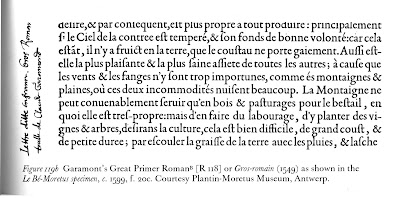
Snap Judgements: New York's Photo League

$
0
0
by Alastair Johnston
 

The Radical Camera: New York's Photo League, 1936–1951
Yale University Press, edited by Mason Klein and Catherine Evans, 248 pp., with 150 duotones and 76 B&W images.

This book and touring exhibition presents a comprehensive look at a little-known and important American art organization of the mid-twentieth century. Formed in 1936, the Photo League of New York shut down 15 years later during the Red Scare of the McCarthy era. Their parent organization, the Film & Photo League, was formed in 1930 as part of FDR's New Deal to make documentary films. A number of Leftists and Jews were prominent in their ranks. Like the WPA before them these artists had an incredible empathy for their subjects, and believed in art in the service of progressive social activism. The Photo League, led by Paul Strand, Walter Rosenblum and Sid Grossman, broke away from the parent film unit after an unresolved fight over aesthetic versus political approaches to their work. There were some 400 members over the years, and today we recognize the big names of street photography among them: Lisette Model, Weegee, W. Eugene Smith, Berenice Abbott, Lou Stoumen, Aaron Siskind, Jerome Leibling, Dan Weiner, and many others who created a new aesthetic, both in terms of the composition and printing of their work, and in the subject matter.
Lisette Model, "Lower East Side, ca. 1940"

Lewis Hine was obviously a key figure in their formation, in fact he left his archives to the Photo League (and this was the beginning of a nightmare as one unscrupulous member -- Rosenblum -- started printing Hine's negatives and added a studio stamp to the back to make them appear to be vintage prints, as a marketing scam). Hine, like Jacob Riis, pioneered documentary portraits of the grim life of "the other half." Riis was the first to use flash photography to cast light on the seedy all-night dives or hobos' lairs under bridges. Hine snuck into factories to find children tending huge dangerous machines: his work had a major impact on child labor laws in the USA. His oeuvre gave the Photo League permission not to be squeamish and to bare all in their own work. Newly introduced hand-held 35 mm cameras -- also embraced by Paul Strand -- made spontaneous street photography possible and, despite any political agenda, the members were able to incorporate poetry and self-expression into their work.

Marvin E Newman, "Halloween, South Side, 1951"

I had always loved Helen Levitt until I found out she cheated: she had a spy camera that had a mirror in it so she would be facing one way and looking in the viewfinder, as if she were photographing the street, but in reality was taking a picture at 90 degrees of people on the stoop. To me it's important to engage the subject in the photo for a successful image. However there are other, unknown, photographers in here that catch those "Levitt" moments with aplomb and, presumably, without resorting to mirrors. Marvin E Newman's "Halloween, South Side, 1951," is a classic "Levitt" shot, and one that has not been widely published. Quite a few of the Photo League photographers, such as Arthur Leipzig, were interested in children's games. Similarly the caught-on-the-fly moments of Austrian Robert Frank are foreshadowed in the cauldron of the Photo League.

In the case of the WPA photographers, their government-backed mandate was to document the migration of farmers in the Dust Bowl: for the Photo League the poor inhabitants of Harlem in their backyard became the subject of a documentary study from 1936-40.

Vivian Cherry, "Game of Lynching, East Harlem, 1947"

"Game of Lynching," a series by Vivian Cherry (a former dancer who took up photography when she was injured), shows two little white boys holding the arms of an African American youth as part of a very different game. Cherry sent the images to McCall's who rejected them saying they were a little too real for publication and they did not think their readers could empathize or identify with the protagonists. But the rise of the picture press, such as Life, Look and PM magazines, was a great forum for these artists from the Depression through the Second World War and on to the burgeoning Civil Rights struggle. To bolster their ranks the Photo League also got Jack Delano, Arthur Rothstein and John Vachon, three of the great unsung heros of the WPA, as members. (Because Walker Evans and Dorothea Lange are such giants, history has unfairly overlooked the many other talented artists who worked for Roy Stryker in the Farm Security Administration.)

Aaron Siskind, "The Wishing Tree, Harlem, 1937"

Aaron Siskind became a well-known teacher, and as a member of the Photo League he had the idea of the Harlem project: Ten photographers (Max Yavno and Morris Engel included) documented life in the poor black neighborhood of Manhattan and then staged exhibits around New York to show the results. Unfortunately, in Siskind's re-edited version of the project, the images tended to reinforce stereotypes of impoverishment.

Arthur Leipzig, "Ideal Laundry, 1946"

In 1951 the Photo League members were blacklisted for leftist leanings but had already made their mark in paving the way for street photographers. Soon MoMA and other important venues would accept street photography into their exhibitions. After the group was disbanded, Morris Engel and Ruth Orkin turned to cinema and made the wonderful "Little Fugitive" which is available on DVD.

Jerome Leibling, "Butterfly Boy, New York, 1949"

The exhibit is on view through Jan 21 at the Jewish Museum in San Francisco then goes to the Norton Museum of Art in West Palm Beach through April 2013.
__________
__________

The Mother of Political Satire, or Why Did Yankee Doodle Call His Hat Macaroni? A Booktryst Golden Oldie

$
0
0
by Stephen J. Gertz


 Despite their wide popularity and broad distribution, and their importance in the history of British caricature, the color-plate books and albums of Mary Darly are now quite rare.

Who was Mary Darly?

The Paris She Cleaner.

"Although most well-known cartoonists have been men, one of the most influential early figures in the field was a woman, Mary Darly. Though often overlooked in histories of the subject, women have played a significant part in the development of cartoons and caricature in Britain from its beginnings in the days of Hogarth almost 300 years ago right up to the present… However, the mother of them all, perhaps, was the eighteenth-century artist, engraver, writer, printseller, publisher and teacher, Mary Darly (fl.1756-79), who also wrote, illustrated and published the first ever manual on how to draw caricatures" (Bryant, The Mother of Pictorial Satire).

Her husband, Matthew, had established a print publishing and retaiing shop in 1756. The two immediately published a wealth of caricatures. What remains significant about this burst of activity is that it was the first time that caricature, which exaggerated facial features to comic effect, was joined to political satire.


"During the early 1770s, the rage for caricatures in London was fueled by the activities of the print publishers, Matthew and Mary Darly, who flooded the market with their wry visual commentaries on social life. Among their productions were dozens of prints representing a group of men labeled by contemporaries as 'macaronis,' allegedly because of their affectation of foreign tastes and fashions. The macaronis were an ephemeral phenomenon, as well as an extension of the fops and beaus of the earlier part of the century. They were called, among other epithets, 'noxious vermin,' 'that doubtful gender,' and 'amphibious creatures,' and were compared variously to monsters, devils, reptiles, women, monkeys, asses, and butterflies.

The French Marow-Bone Singer.

“Their concern for elaborate clothing, including tight trousers, large wigs, short coats, and small hats made them the ridicule of their generation, who focused on their gender ambiguity and the dangers of their conformity to foreign and effeminate fashion. A contemporary pamphlet, The Vauxhall Affray, sums up this view: 'But Macaronies are a sex Which do philosophers perplex; Tho' all the priests of Venus's rites Agree they are Hermaphrodites. This gender ambiguity is the aspect of the representational life...' (West, The Darly Macaroni Prints and the Politics of "Private Man." Eighteenth-Century Life 25.2 [2001] pp.170-182).

The Female Conoiseur.

"…the marks that had been codified into the macaroni type [were]: fine sprigged fabric, tight clothes, oversized sword, tasseled walking stick, delicate shoes, and, most recognizably, an enormous wig. This wig, combining a tall front with a fat queue or "club" of hair behind, was the feature that epitomized the macaroni's extravagant artifice during London's macaroni craze of the early 1770s. Named for the pasta dish that rich young Grand Tourists brought back from their sojourns in Rome, the macaroni was known in the 1760s as an elite figure marked by the cultivation of European travel. But as The Macaroni and Theatrical Magazine explained in its inaugural issue in 1772, 'the word Macaroni then changed its meaning to that of a person who exceeded the ordinary bounds of fashion; and is now justly used as a term of reproach to all ranks of people, indifferently, who fall into this absurdity.' Macaroni fashion was contagious, and as it spread beyond its original cadre into the rising..." (Rauser, Hair, Authenticity, and the Self-Made Macaroni. Eighteenth-Century Studies 38.1 [2004] pp. 101-117).

The Surry Macaroni.

"In 1762 [Mary Darly] assumed responsibility for this aspect of their business...She described herself as ‘Fun Merchant, at the Acorn in Ryder's Court, Fleet Street’ (Clayton, 215)...When, in early 1762, a new shop at the Acorn in Ryder's Court near Leicester Fields began to advertise caricatures, it was Mary Darly who was named as publisher. Her principal targets were the dowager princess of Wales, her alleged paramour the earl of Bute, and his allegedly locust-like Scottish friends and relations, of whom the Darlys promised prints ‘as fast as their Needles will move, and Aqua fortis Bite’ (Public Advertiser, 28 Sept 1762).

The Unfortunate Macaroni.

“To this end Mary welcomed contributions from the general public: ‘Gentlemen and Ladies may have any Sketch or Fancy of their own, engraved, etched &c. with the utmost Despatch and Secrecy’ (ibid.). That she herself was the etcher of these designs was established by her offer to ‘have them either Engrav'd, etched, or Dry-Needled, by their humble Servant’ (ibid.). In October she published the first part of Principles of Caricatura (1762) which according to the title-page provided guidance in drawing caricatures and which reinforced her offer to give exposure in the capital to the ideas of provincial amateurs: ‘any carrick will be etched and published that the Authoress shall be favoured with, Post paid’...Mary Darly fostered enthusiasm for graphic satire, cultivated a polite audience, and increased sensitivity to caricature as an artistic convention.

The Fortunate Macaroni.

"In the early 1770s...the Darlys relinquished political satire and instead published satires of fashion, manners, and well-known individuals. Inviting sketches and ideas, they warned that ‘illiberal and indelicate Hints, such as one marked A. Z. [were] not admissible’ and that ‘low or political Subjects will not be noticed’ (Public Advertiser, 15 and 22 Oct 1) Contributions were received from a variety of amateurs, including the talented William Henry Bunbury, Edward Topham, and Richard St George Mansergh. Prints mocking affected macaronis and extremes of dress and coiffure were characteristic. In 1773 they held an exhibition of 233 original drawings for prints. Collected sets were offered from 1772 with a portrait of Matthew Darly dated 1771 as frontispiece (BM 4632). (Timothy Clayton, Matthew Darly. Oxford Dictionary of National Biography, Oxford University Press, 2004).

I’m writing as I ride a pony into town, a feather in my hat. Suddenly, I have an urge for pasta. Why? Where is Mario Batali when you need him?

The Martial Macaroni.

The Macaroni character plays a role in the American Revolution. "Singing a song in Revolutionary America was not necessarily an innocent act...One of these songs [Yankee Doodle], which told the story of a poorly dressed Yankee simpleton, or 'doodle,' was so popular with British troops that they played it as they marched to battle on the first day of the Revolutionary War. The rebels quickly claimed the song as their own, though, and created dozens of new verses that mocked the British" (Yankee Doodle - Lyrical Legacy at the Library of Congress).

"Why did yankee doodle stick a feather in his hat and call it macaroni? Back in Pre-Revolutionary America when the song 'Yankee Doodle' was first popular, the singer was not referring to the pasta 'macaroni' in the line that reads 'stuck a feather in his hat and called it macaroni.' 'Macaroni' was a fancy ('dandy') style of Italian dress widely imitated in England at the time. So by just sticking a feather in his cap and calling himself a 'Macaroni' (a 'dandy'), Yankee Doodle was proudly proclaiming himself to be a country bumpkin, because that was how the English regarded most colonials at that time" (United States National Institute of Environmental Health Sciences).

Well, there you have it. Is it too much of a stretch to wonder if the culture wars in America began when colonial hayseeds internalized their status as an elite class of Revolutionary War citizens to proudly distain intellectualism and urbanity?

I don’t know. But my parrot has just dropped a flight feather into my bowl of penne bolognese, which I shall now proudly place upside down upon my head as a pasta-hat in tribute to the Yankee-yokels who threw the Brits’ scorn back at them with wit. I am, as ever, the soul of patriotic dignity.

American humor: It’s straight line from Yankee-Doodle to Hee-Haw, despite the detour through the Borscht Belt.
__________

Images from 24 Caricatures by Several Ladies, Gentlemen, Artists, &c. and volume ll of Caricatures, Macaronies & Characters by Sundry Ladies, Gentle.n, Artists, &c. [London]: M Darly, No. 39 Strand, 1771-1772, and courtesy of David Brass
__________
__________
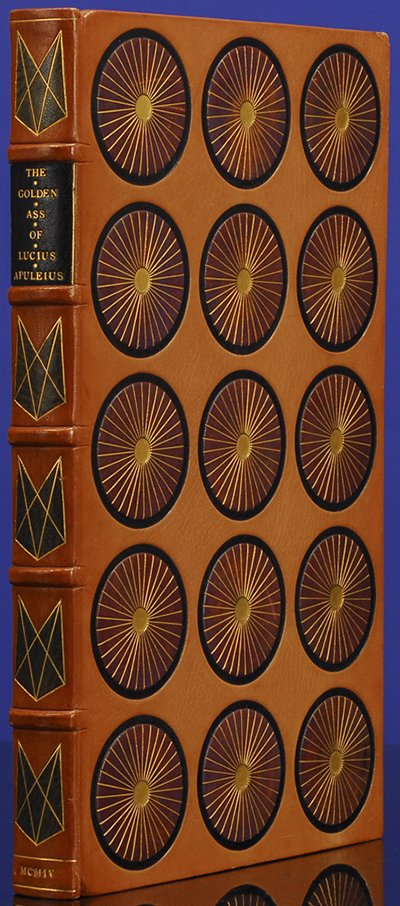
Thomas De Quincey Writes While High As A Kite

$
0
0
by Stephen J. Gertz

"I was necessarily ignorant of the whole art and mystery of opium-taking: and, what I took, I took under every disadvantage. But I took it: -- and in an hour, oh! Heavens! what a revulsion! what an upheaving, from its lowest depths, of the inner spirit! what an apocalypse of the world within me! That my pains had vanished, was now a trifle in my eyes: -- this negative effect was swallowed up in the immensity of those positive effects which had opened before me -- in the abyss of divine enjoyment thus suddenly revealed. Here was a panacea - a [pharmakon nepenthez] for all human woes: here was the secret of happiness, about which philosophers had disputed for so many ages, at once discovered: happiness might now be bought for a penny, and carried in the waistcoat pocket: portable ecstasies might be had corked up in a pint bottle: and peace of mind could be sent down in gallons by the mail coach" (Confessions of an English Opium-Eater).

At an unknown date post-1804, the year that he first tried opium at age nineteen, Thomas De Quincey, famed author of Confessions of an English Opium-Eater (anonymously published in London magazine in 1821 and in book form in 1822), was working on a draft of an as yet unidentified or unpublished essay.

In 250 words over eighteen lines with numerous cancellations and insertions, De Quincey, apparently after chug-a-lugging laudanum (tincture of opium), to which he was addicted, took flight and soared to Xanadu as a  phoenix ecstatically lost in the ozone and content to be above it all, a mummified skeleton lying in a blissful state. That one-page, drug-addled manuscript has now come to auction.

It reads, in part:

"In a clock-case housed in a warm chamber of a spacious English mansion (inevitably as being English, so beautifully clean, so admirably preserved, [noise there is none, dust there is none, neither moth nor worm doth corrupt] how sweet it is to lie! – If thieves break through and steal, they will not steal a mummy; or not, unless they mistake the mummy for an eight-day clock. And if fire should arise, or even if it should descend from heaven is there not a Phoenix Office, able to look either sort of fire (earthly or heavenly) in the face ... Mummy or anti-Mummy, Skeleton or Anti-Skeleton, the Phoenix soars higher above both, and flaps her victorious wings in utter defiance of all that the element of fire can accomplish—making it her boast to ride in the upper air high above all malice from earthly enemies...."

To paraphrase Ernest Hemingway, Write high, edit sober. It appears, however, that De Quincey, never completely free of opium's grip, remained stoned through the editorial process. This is is an opium-soaked apparition, a fantastic proto-Surrealist Gothic phantasmagory. It must have seemed to De Quincey that he had broken the boundaries of prose and ascended to that enchanted place where reveries take flight onto paper without volition or physical exertion, highly automatic writing while under the spell of the Oneiroi, the dream-spirits who emerge like bats from their deep cavern in Erebos, the land of eternal darkness beyond the rising sun, the infinite night that day cannot break. Don't mess with the Muse, feed Her. Judging by his penmanship there was laudanum in his inkwell.


This De Quincey manuscript, an early example of high-lit. during the Romantic period demonstrating the effect of opium on literary creation, is being offered at Bonham's Fine Books & Manuscripts sale, February 17, 2013, in San Francisco where it is estimated to sell for $800-$1200.
__________

Manuscript image courtesy of Bonham's, with our thanks.
__________

Allen Ginsberg On Neal Cassady's Ashes

$
0
0
by Stephen J. Gertz


On January 17, 1971, a college student in Pennsylvania wrote a letter seeking assistance from Beat poet Allen Ginsberg. 

Dear Mr. Ginsberg,

I am a junior at Bucknell University at Lewisberg. This winter I have been gathering material for an exhibit to be displayed in the University library the latter part of this spring and through the summer months. I have chosen 'Allen Ginsberg -- Profile of a Poet' to be the theme.

I have devoted a great deal of time and effort to this project -- research and collection of displayable items of your notable career.

The exhibit, I think, will be a good one, but it has nothing personal relating to the subject.

In short, I have written you with the greatest of hope that you would send me your autograph (letter or simply signature) to make the exhibit more interesting. Your effort, believe me, will be greatly appreciated.

Cordially,

Larry Diefenbach

Ginsberg immediately replied upon receipt of the letter on January 21st, returning it with his holographic response.

Larry -

Here's a poem + some odd items you may'nt have seen?

Good luck - Allen G. Jan 21, 1971


Delicate eyes that blinded blue Rockies, all ash
Nipples, ribs touched w/my thumb are ash
Mouth my tongue touched once or twice all ash
bony cheeks soft on my belly are Cinder, ash
earlobes & eyelids, youthful cock-tip, curly pubis
breast warmth, man palm, high school thigh,
baseball biceps arm, asshole anneal'd to
               silken skin all ashes, all ashes again.


Ginsberg dates the poem's creation June 1968, signs it, and includes his hand-drawn Buddha's footprint logo.

Neal Cassady, Beat Generation muse and the vivid model for wild man Dean Moriarty in Kerouac's On the Road and Ginsberg's on-and-off lover for twenty years, died in San Miguel de Allende, Guanajuato, Mexico on February  4, 1968. His body was found by the railroad tracks just outside of town; he had passed-out after walking the tracks on a cold and rainy night after attending a wedding party and was discovered in a coma. He died a few hours later, just shy of his 42d birthday after a lifetime of terminal velocity in the pursuit of heightened existence. Cassady was cremated and the disposition of his remains became contentious, with his wife, Carolyn, fending off two women who laid claim to his heart while he was alive, and post-mortem. 

Allen Ginsberg and Neal Cassady, used car lot, San Francisco, 1955.
©Allen Ginsberg Estate

His "ashes were the subject of squabbles, first between Carolyn and 'a wild-looking hippie girl' and then with Diana Hansen, to whom Neal had got hitched in 1950, while still married to Carolyn. She called repeatedly, requesting a portion. Carolyn resisted at first, but then 'sent Diana some ashes, with love'” (NY Times, Nov 19, 2006).

Ginsberg later wrote:

"in 1968, I went down from San Francisco to visit Carolyn Cassady in Los Gatos. There's a poem of mine called 'On Neal's Ashes' which is a record of that visit, of opening the wooden container from Mexico City which had a silken bag full of his ashes. I opened the box and touched my finger inside of it and then looked in it and there was all this black and white cinder with a little rough stuff in it, pieces of bone that were burnt and blackened. So I said, 'Oh, so that's what happened to Neal Cassady.' It seemed magical that he'd disappeared and transformed into this tiny pound of gritty ashes. But it was definitive as his death. I realized it had all come to that. I hadn't seen him for a number of years and his disappearance was no big deal until I actually saw the remains of his body" (A Valentine for William Blake, Introduction to an unpublished manuscript of Ginsberg's Blake lectures).

This letter is being offered at Bonham's-San Francisco in their Fine Books & Manuscripts sale on February 17, 2013. It is estimated to sell for $800-$1200.


Ginsberg can be heard reciting On Neal's Ashes on Holy Soul Jelly Roll Vol. 4: Ashes & Blues.
___________
Letter images courtesy of Bonham's, with our thanks.
___________

Raymond Chandler Gripes To His Agent About Agents

$
0
0
by Stephen J. Gertz


In a letter dated July 11, 1952, Raymond Chandler wrote his agent, H.N. Swanson ("Swanie") mentioning, among other things, that he is "still fussing around with the end of a book, a draft of which I unwisely sent East to Carl Brandt and Bernice Baumgarten [of Brandt & Brandt of New York, Baumgarten an associate and wife of novelist James Gould Cozzens] and received in return a lot of picayunish criticism which annoyed me without being in the least helpful."

Chandler goes on to muse about not being the sort of writer who publishes in the Saturday Evening Post, and reflects on the relationship between writers and agents. "During my fairly long association with poor old Sydney Sanders, I did learn exactly how to benefit by the advice of New York literary agents. Thank them politely, and then do something else." Brandt and Baumgarten were Chandler's former agent and editor, respectively; the manuscript they had criticized was The Long Goodbye. (See Selected Letters, p 315n.)


In another typically colorful and direct letter by Chandler to Swanson, dated December 5, 1952 and three pages in length, Chandler explains why he wants to handle matters concerning his book rights himself. Chandler begins by "remarking in passing that you (including Eddie) are the only agent that I have been able to like," then goes on to once again air his grievances with former agents Baumgarten and Brandt, alluding to their criticism of his draft of The Long Goodbye.


He then launches into a page and a half critique of the ineffectualness and superfluousness of literary agents in general. "The English agent and the American agent can't even write a contract; they don't know when royalty statements are due; they don't know if they are paid when they should be paid; they don't even know when the books are published unless they get author's copies, and they don't always get author's copies. The whole thing is just a bluff." Elsewhere he declares, "I will never again submit a book manuscript to an agent unless a publisher has first approved it. If I have to get kicked in the teeth, okay, but I won't take it from anybody but the head man." 

Chandler provides several other reasons for wanting to handle his book rights himself, and offers to let Swanson continue to handle matters related to motion picture, television, radio, and serial rights.

I was acquainted with Swanie (1899-1991), who was still active when I was a story editor in Hollywood during the early 1980s; I spoke to him a few times. The dominant literary agent in his heyday he was still respected as one of the greats by those in the know; his client list was awe-inspiring. He began as a writer and editor; he knew the writers soul and how to deal with those who would rob it and then pick their pockets. He was of the old-school and by the 1980s was sort of a fossil in the new Hollywood to those who didn't know any better.

"Harold Norling Swanson, known as Swanie, was a native of Centerville, Iowa, and a graduate of Grinnell College. He began his career as a writer and was a founder and the editor for eight years of College Humor, a Chicago-based monthly that became a showcase for new talent. In 1931, he moved to California and became a producer, making about a dozen films for RKO.

"Three years later, Mr. Swanson rented a building on Sunset Boulevard and became a pioneering literary agent. By 1939, when 110 screen writers were under contract to 20th Century Fox, he represented 80 of them.

"Among his early clients for screenplays were William Faulkner, F. Scott Fitzgerald, Pearl Buck and Raymond Chandler. More recently, he represented the Hollywood efforts of writers like Joyce Carol Oates, Paul Theroux and Joseph Wambaugh. Among the scripts he sold were the 1946 version of "The Postman Always Rings Twice," "The Big Sleep" (1946), "Old Yeller" (1957), "Butterfield 8" (1960) and "The Mosquito Coast" (1986)" (NY Times obit).
These letters are being offered by Bonham's in their Fine Books & Manuscripts sale, February 17, 2013.
___________
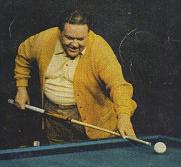
Images courtesy of Bonham's, with our thanks.
__________
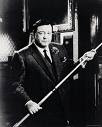
___________
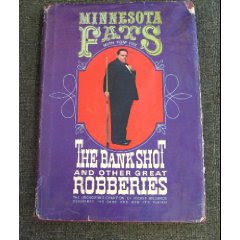
Viewing all 472 articles
Browse latest View live


Latest Images